
From the Papers: “It will never do to be behind the times”
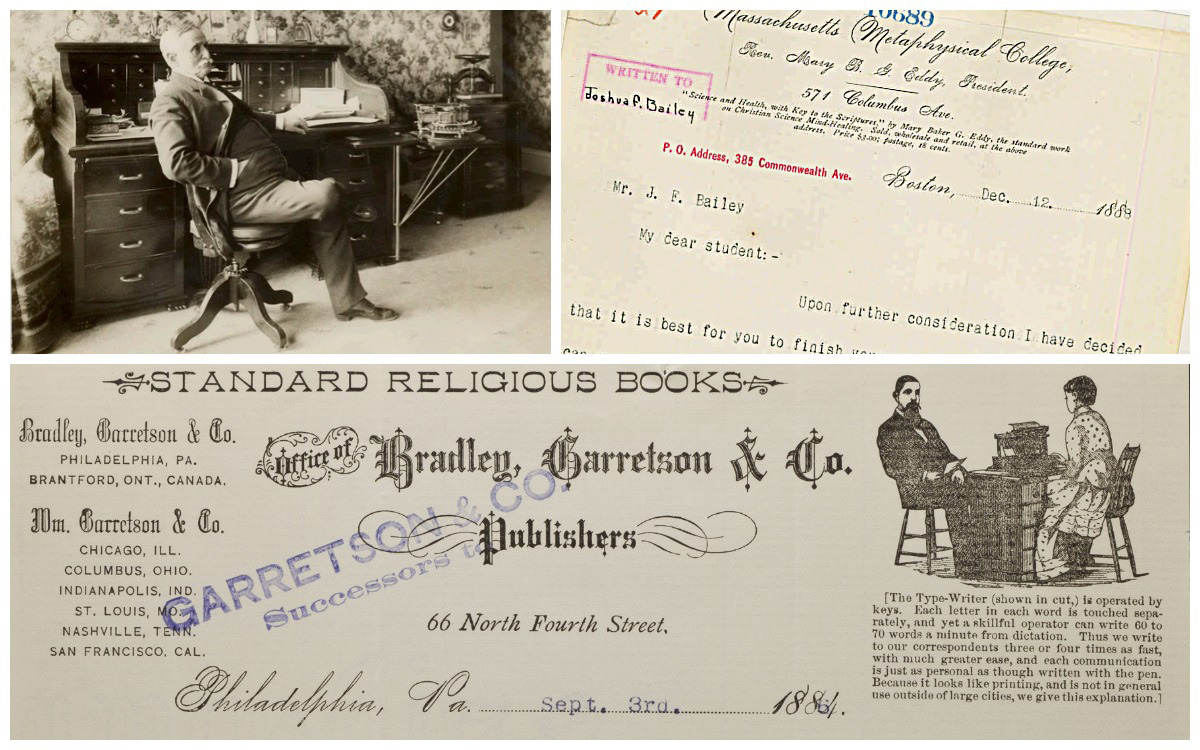
Portrait of Calvin Frye, American Press Association, P00752. Eddy to Joshua A. Bailey, 12 December 1888, L10689. Bradley, Garretson & Co. to Mary Baker Eddy, September 3, 1886, 944.92.009.
The United States of the 1880s was characterized by innovation and mechanization. From transportation to communications to the domestic sphere, new technologies were appearing in nearly every area of life. While working to digitally publish correspondence from the mid-1880s in the Library’s Mary Baker Eddy Collection, our Papers team found a curious piece of letterhead depicting one aspect of that inventive time as it relates to Eddy’s correspondence: the advent of the typewriter.
On September 3, 1886, Garretson & Co.—a Philadelphia publishing company—wrote to Mary Baker Eddy on behalf of a customer wishing to order her book Science and Health with Key to the Scriptures. While such letters were common, what stood out to us was the fact that the letter was typed, not handwritten. In addition, the letterhead itself included an illustration of a woman operating a typewriter, along with this explanation:
The Type-Writer (shown in cut,) is operated by keys. Each letter in each word is touched separately, and yet a skillful operator can write 60 to 70 words a minute from dictation. Thus we write to our correspondents three or four times as fast, with much greater ease, and each communication is just as personal as though written with the pen. Because it looks like printing, and is not in general use outside of large cities, we give this explanation.1
Along such lines, one might suppose that the typewriter’s noted ease and efficiency would have caused it to catch on like wildfire. However, that was not the case. Although the first commercially practicable typewriter was patented in 1868 and began its manufacture in 1873,2 Garretson & Co.’s basic explanation of a typewriter on their letterhead in 1886 indicates that some 13 years later it was still a technology many people had not yet encountered.
One reason was undoubtedly its price. At $125—the equivalent of about $4,000 in today’s money—it was financially out of reach for most individuals and smaller businesses. By further comparison, a typewriter cost twice as much as an average horse-drawn carriage.3
Another possible reason for the typewriter’s slow takeoff was that it was primarily marketed to those preparing manuscripts—such as “ministers, lawyers, authors, stenographers, and all who desire to escape the drudgery of the pen”—rather than to business offices engaged in daily correspondence.4 Indeed, the earliest typed letter in our collection, dated April 15, 1883, was written to Eddy by her student Eldridge J. Smith, a lawyer. He began, “I will attempt an answer to your kind favor received several days ago on the type writer I can now after a little practice write at least as rapidly and certainly much more legibly, than with a pen.”5 When Garretson and Co. wrote to Eddy more than three years later, typewritten letters were still rare. Out of the approximately 1,850 letters she received in 1886, only nine were typed—fewer than one-half of one percent.
The typewriter’s initial appeal to ministers and authors is consistent with the fact that Eddy herself obtained a typewriter earlier than most. When asked to address “the pursuit of modern inventions,” she once told the New York Herald:
Oh, we cannot oppose them. They all tend to newer, finer, more etherealized ways of living. They seek the finer essences. They light the way to the Church of Christ. We use them, we make them our figures of speech. They are preparing the way for us.6
She was known to embrace new technologies for herself, as well as in general,7 and this is another instance when she proved to be ahead of the times.8 The earliest correspondence we can find that was typewritten on Eddy’s behalf was a letter dated August 14, 1887, to James Henry Wiggin.9 The next doesn’t appear until December 12, 1888, to Joshua F. Bailey.10
It is interesting to note that the prevailing attitude early on was that typewritten correspondence was impersonal and possibly even insulting—surely another reason for its slow acceptance in general. One historical source explains:
Many saw the typed page, unlike messages written out in longhand by the sender, as implicitly discourteous; they were viewed as impersonal and lacking in privacy because a clerk, not the person who signed the message, presumably had to turn out the typed page. Others objected to typed communications because of a perceived implication that the recipient could not read script.11
This was the perception that Garretson & Co.’s letterhead attempted to assuage in noting that “each communication is just as personal as though written with the pen.”
Over the 1890s, typed correspondence in the Mary Baker Eddy Collection slowly increased, until by 1900 nearly 25 percent of Eddy’s incoming correspondence was typewritten. Her long-serving secretary, Calvin A. Frye, taught himself to use a typewriter,12 and from the late 1880s through the early 1900s he likely produced the majority of her outgoing typewritten correspondence. Eddy’s student Harriet L. Betts, who worked on the staff at her Concord, New Hampshire, home in 1902 and 1903, recalled that “Mr. Frye’s typewriter was apt to be working long hours during the night.”13 Eventually the demand for skilled typists to handle the increasing volume of Eddy’s correspondence necessitated hiring more secretaries. In addition to Frye, George H. Kinter and Lewis C. Strang served as secretaries for periods of time between 1903 and 1907. In 1907 Irving Tomlinson was brought on, and in 1908, after Eddy’s move to her new home in Chestnut Hill, Massachusetts, she employed Adam Dickey and William Rathvon as well. Frye, Tomlinson, Dickey, and Rathvon each had their own typewriter, replicas of which can still be seen in that home today.14
An ancillary benefit of the typewriter’s invention was that it opened up a whole new field of employment—especially for women. An 1899 Christian Science Sentinel article highlighted this boon:
In 1870 the census reported only one hundred and fifty-four shorthand writers in the United States. Owing to the invention of the typewriter, there are now about thirty-five thousand stenographers and typewriters, of whom twenty-one thousand are women.15
Therefore it was likely no coincidence that the person depicted using the typewriter on Garretson and Co.’s 1886 letterhead was a woman. And as early as 1887, Abbie M. Lyons, an enterprising woman who was recently widowed and supporting six children in nearby Newton Upper Falls, Massachusetts, reached out to Frye (in a flawlessly typed letter) offering her services as a typist.16
Attitudes about the acceptability of typewritten correspondence were evolving, as evidenced by this passage from a Saturday Evening Post article reprinted in the Sentinel in November 1900:
The value of the typewriter is so great and is demonstrated in so many directions that we often wonder how we got along without it. It expedites business, saves time and eyes, increases legibility and courtesy, and removes every excuse for bad spelling and punctuation.17
Encountering the slow but steady increase of typed correspondence in the Mary Baker Eddy Collection enables us to trace that evolution in thought. Eddy’s own ready embrace of a technology that the rest of society was slower to accept points to her perspective on progress more generally:
This age is reaching out towards the perfect Principle of things; is pushing towards perfection in art, invention, and manufacture. Why, then, should religion be stereotyped, and we not obtain a more perfect and practical Christianity? It will never do to be behind the times in things most essential, which proceed from the standard of right that regulates human destiny. Human skill but foreshadows what is next to appear as its divine origin.18

- Garretson & Co. to Eddy, 3 September 1886, IC944.92.009.
- “Production on the Sholes and Glidden Type-writer Began,” Library of Congress, n.d., accessed 27 January 2026, https://guides.loc.gov/this-month-in-business-history/march/typewriter-production-began
- “History,” Antique Typewriters: The Martin Howard Collection, n.d., accessed 27 January 2026, https://www.antiquetypewriters.com/about/history/
- “History,” Antique Typewriters: The Martin Howard Collection, n.d., accessed 27 January 2026, https://www.antiquetypewriters.com/about/history/.
- Eldridge J. Smith to Eddy, 15 April 1883, IC382.50.021.
- Mary Baker Eddy, The First Church of Christ, Scientist, and Miscellany (Boston: The Christian Science Board of Directors), 345.
- See “What were Mary Baker Eddy’s views on technology?” 1 December 2017, https://www.marybakereddylibrary.org/research/mary-baker-eddys-views-technology/.
- See “Technology in Mary Baker Eddy’s Household,” 18 December 2012, https://www.marybakereddylibrary.org/research/technology-in-mary-baker-eddys-household/. We don’t know the exact details of the first typewriter used by Eddy’s staff. But a letter to Calvin A. Frye dated October 31, 1888, from a dealer of inking attachments for Hammond typewriters, ended with the line “will you please allow me to put one on your Type-Writer?” (J. W. Tallmadge to Calvin A. Frye, 31 October 1888, IC989.98.001). So Eddy’s household clearly had owned a Hammond typewriter prior to that time.
- Eddy to James Henry Wiggin, 14 August 1887, L07617.
- Eddy to Joshua A. Bailey, 12 December 1888, L10689.
- Henry E. Mattox, “Technology and Foreign Affairs: The Case of the Typewriter,” American Diplomacy, December 1997, https://americandiplomacy.web.unc.edu/1997/12/technology-and-foreign-affairs-the-case-of-the-typewriter/
- Irving C. Tomlinson, “Mary Baker Eddy: the Woman and the Revelator,” 1932, Reminiscence, 774.
- Harriet L. Betts, “Reminiscences of Mrs. Eddy,” n.d., Reminiscence, 21.
- Armin Sethna, “A Tale of Three Typewriters,” Longyear Museum, 19 June 2024, https://www.longyear.org/learn/research-archive/mrs-eddys-chestnut-hill-household/#inline-footnote-4
- “Benefits to Wage-earners,” Christian Science Sentinel, 23 February 1899, https://sentinel.christianscience.com/issues/1899/2/1-26/miscellany?s=copylink
- She wrote: “If you are in need of a stenographer and operator for the ‘Hammond Type Writer,’ I would be pleased to call on you. I feel confident that my speed in shorthand, and also on the type writer, is all that would be required in ordinary business correspondence” (Abbie M. Lyons to Frye, 26 October 1887, IC965.95.063).
- Lynn Roby Meekins, “The Typewriter as Teacher,” Sentinel, 1 November 1900, https://sentinel.christianscience.com/issues/1900/11/3-9/the-typewriter-as-a-teacher?s=copylink
- Eddy, Miscellaneous Writings 1883–1896 (Boston: The Christian Science Board of Directors), 232.