
From the Papers: Dr. M. Augusta Fairchild corresponds with Mary Baker Eddy
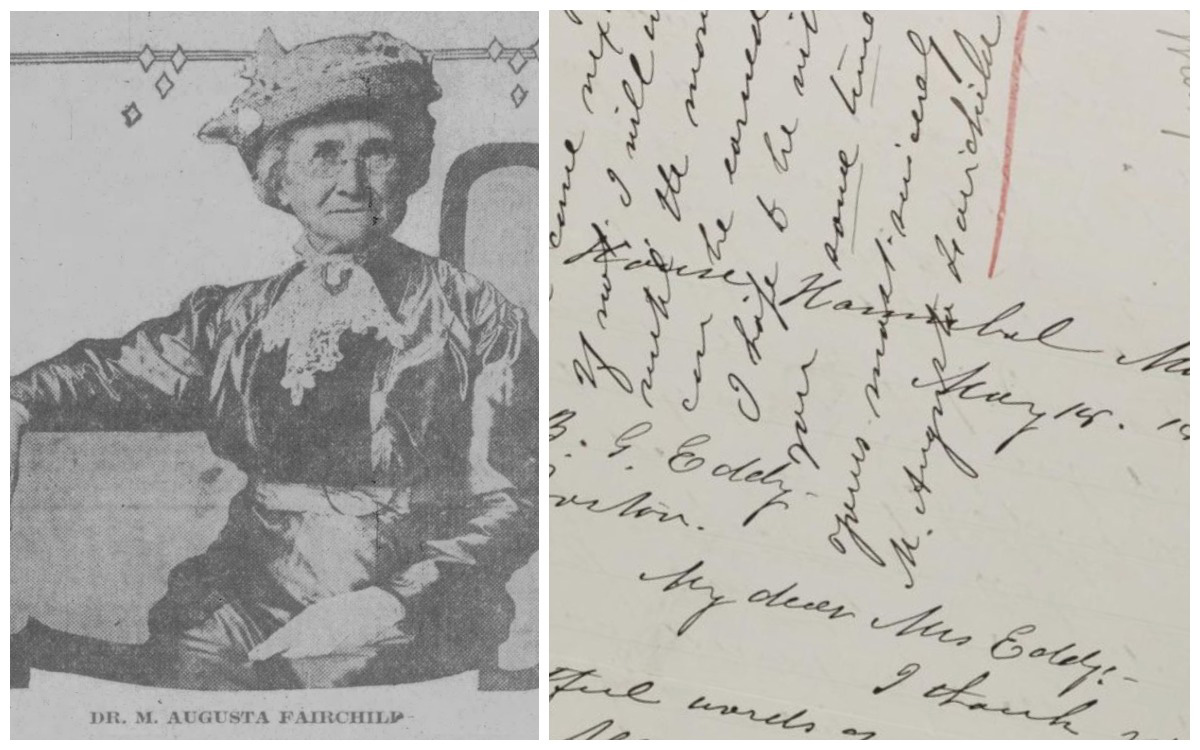
Dr. M. Augusta Fairchild, Los Angeles Evening Post-Record, June 24, 1913; Fairchild to Mary Baker Eddy, May 18, 1885. 667A.72.014.
In April 1885, Dr. M. Augusta Fairchild (1834–1923) wrote to Mary Baker Eddy. She had applied Eddy’s Christian Science teachings to her “worse chronic case of uterine affection, lung trouble, dyspepsia” and reported that she had achieved great physical improvement in less than two weeks.1 Like Fairchild, many of those who sought out Eddy’s teachings were themselves pioneers in various fields, looking for deeper answers to the physical and spiritual challenges of their time.2 This article highlights Fairchild’s life and work as a female physician and health reformer, whose journey ultimately led her to Christian Science.
Early life and a calling to medicine
Marie Augusta Fairchild was born in Newark, New Jersey. Despite her early interest in medicine,3 it took a severe health crisis for her to fully commit to the profession. At 20 she suffered from “brain fever,” and her recovery was slow. When she finally regained the ability to speak, she reportedly told her nurse, “God has spared me, I mean now to live for a purpose…I mean to be a physician.” To that end, in 1857 she enrolled at the New York Hygeio-Therapeutic College, an institution dedicated to natural healing while rejecting traditional medicine.4 She was one of the first women to graduate with a medical degree, in 1860.5
Advocating for women and health reform
Fairchild entered the medical field at a time when women doctors were widely viewed with suspicion. In an 1861 article titled “Female Physicians,” she defended a woman’s place in medicine, arguing that the “healing art” was aligned with women’s natural roles as teachers and caregivers. She recognized that female patients were often uncomfortable disclosing their symptoms to male doctors, and posited that this led to misdiagnosis and suffering. By educating and treating women, she maintained, female physicians could bring about a “great work of health-reform.”6
Her desire for health reform extended to a complete rejection of traditional “allopathic” medicine. Fairchild aligned herself with the Hygienic School, which focused on natural remedies such as water cures, diet, fresh air, and exercise. She believed in the restorative power of nature when freed from “drug-poisoning.” In one notable case, she took on a young female patient whom allopathic doctors had deemed a “hopeless” consumptive and successfully restored her to blooming health—a result that “astonished” the local community.7
Fairchild’s commitment to her cause took her on arduous lecture tours throughout the West, enduring difficult travel conditions to spread her message of hygienic reform.8 She eventually established several institutions focused on healing.9 Beyond her clinics, she sought to educate the public through several books she wrote, including How to be Well (1879) and Women and Health (1890).10
Encountering Mary Baker Eddy
Despite her considerable success and prominence as a physician and author, Fairchild still found herself searching for more profound meaning. On August 20, 1884, she wrote a brief letter to Eddy from Hannibal, Missouri, enclosing $3.17 for a copy of her textbook, Science and Health with Key to the Scriptures.11
Just a few weeks later, on September 11, Fairchild wrote a much longer letter to Eddy. Although she was coming from a different and separate healing system in the Hygienic School, she highlighted the deep resonance she felt with Christian Science. She introduced herself and her background as a physician, explaining that while she had enjoyed a successful career lecturing, writing, and occupying a chair at the Women’s Medical College of St. Louis, she was growing dissatisfied with the limitations of her current methods. “I am sick of the way things are done,” she told Eddy.12
Fairchild explained how reading of Science and Health had sparked a shift in her perspective:
I am convinced that for a long time I have been depending less and less on externals, and my best cures have been those made in a way approximating your methods.—
Your book comes to me as a refreshing draught.—I am ready for your teachings. I long to be more and more useful as the years go by.13
Eager to expand her understanding, she inquired about taking a course of lectures with Eddy, asking, “Can I learn both to heal and to teach? Please know that I desire this knowledge not to serve myself, but to help others.”14
Eddy replied to this inquiry, but financial constraints prevented Fairchild’s journey to Boston. Instead, she traveled with a “crippled patient” to study under one of Eddy’s students, Silas J. Sawyer, in Milwaukee.15
Soon Fairchild realized she wanted direct instruction from Eddy. In an April 18, 1885 letter, she wrote, “And now – I want more than he can give. I must not wait, but arrange to avail myself of your instructions”.16 She expressed reverence for Eddy’s discovery, stating she was “blest beyond expression, in the possession of Truth” and reported that she had already begun applying these methods in her practice.
Then Sawyer wrote to Eddy in July 1885, warning her that Fairchild was “mixing [her medical treatments] with metaphysics” and that her deeply ingrained views as a member of the Swedenborgian New Church might color her reception of Christian Science.17 Interestingly, Sawyer also mentioned to Eddy that Fairchild had “ample means,” noting she had paid him $100 for her instruction.
However, Fairchild’s own letters to Eddy paint a different financial picture. She clarified in her April 18 letter that she had actually paid Sawyer $150, though he had allowed her a $50 credit for the patient she brought to him.18 A month later, on May 18, 1885, Fairchild candidly confessed her “impecuniosity” to Eddy. She explained that a Colorado investment had taken “back action” and left her in “tight papers.”19
So eager was Fairchild to pursue study with Eddy that, as collateral for her tuition, she offered to deed her a two-and-a-half-acre lot she owned on Hannibal’s “Reservoir hill”—a bluff overlooking the Mississippi River that she noted Mark Twain praised for its view. “Every day seems a lost one while I work with ‘material methods’ when my convictions lead me so far from them,” she pleaded.20 Despite her sincere desire to study with Eddy, there is no evidence that Fairchild ever did so.
Their correspondence highlights notable overlaps between the lives of these two pioneering women. Both Fairchild and Eddy were prolific writers and educators who recognized the power of the published word to enact change, seeking to empower the individual. Fairchild was drawn to Eddy’s assertion that true healing requires looking beyond physical remedies. Her admission to Eddy that she had been “depending less and less on externals,” as well as her stated desire to abandon “material methods,” has echoes of the Christian Science premise of looking away from the physical body to find healing through spiritual means.21
Augusta Fairchild ultimately remained a practicing physician. Nevertheless, her correspondence with Eddy shows a deep affinity for Christian Science and their shared commitment to the health and well-being of others. Fairchild wrote, “Why, do you half know what you have done, and are doing, for humanity?”22
Please note: Quoted references in our “From the Papers” article series reflect the original documents. For this reason they may include spelling mistakes and edits made by the authors. In instances where a mark or edit is not easily represented in quoted text, an omission or insertion may be made silently.

- M. Augusta Fairchild to Mary Baker Eddy, 18 April 1885, 667a.72.013. https://mbepapers.org/?load=667A.72.013
- To learn about other women doctors who wrote to Eddy, visit From the Papers: Women doctors write to Mary Baker Eddy, 14 March 2022, https://www.marybakereddylibrary.org/research/from-the-papers-women-doctors-write-to-mary-baker-eddy/
- Frances E. Willard and Mary A. Livermore, eds., A Woman of the Century (Buffalo, NY: Charles Wells Moulton, 1893), 283.
- Estelle Lawton Lindsey, ”Making Old People Useful Is Task Assumed by Woman of 79 Years,” Los Angeles Evening Post-Record, 24 June 1913, 4.
- Edward C. Atwater, Women Medical Doctors in the United States Before the Civil War: A Biographical Dictionary (Rochester, NY: University of Rochester Press, 2016), 106.
- M. Augusta Fairchild, “Female Physicians,” Water-Cure Journal, October 1861, 84.
- Fairchild, “Astonished,” Water-Cure Journal, 82.
- Fairchild, “Slough,” Herald of Health, June 1864, 234.
- Atwater, Women Medical Doctors, 107–108.
- “How To Keep Ourselves Well,” Jackson Citizen Patriot, 22 December 1882, 3. Willard and Livermore, A Woman of the Century, 283.
- Fairchild to Eddy, 20 August 1884, 667A.72.010. https://mbepapers.org/?load=667A.72.010
- Fairchild to Eddy, 11 September 1884, 667a.72.011. https://mbepapers.org/?load=667A.72.011
- Fairchild to Eddy, 11 September 1884, 667a.72.011. https://mbepapers.org/?load=667A.72.011
- Fairchild to Eddy, 11 September 1884, 667a.72.011. https://mbepapers.org/?load=667A.72.011
- Fairchild to Eddy, 18 April 1885, 667a.72.013. https://mbepapers.org/?load=667A.72.013
- Fairchild to Eddy, 18 April 1885, 667a.72.013. https://mbepapers.org/?load=667A.72.013
- S. J. Sawyer to Eddy, 18 July 1885, 237AP2.38.007. https://mbepapers.org/?load=237AP2.38.007
- Fairchild to Eddy, 18 April 1885, 667a.72.013. https://mbepapers.org/?load=667A.72.013
- Fairchild to Eddy, 18 May 1885, 667a.72.014. https://mbepapers.org/?load=667A.72.014
- Fairchild to Eddy, 18 May 1885, 667a.72.014. https://mbepapers.org/?load=667A.72.014
- Fairchild to Eddy, 11 September 1884, 667a.72.011. https://mbepapers.org/?load=667A.72.011; Fairchild to Eddy, 18 May 1885, 667a.72.014. https://mbepapers.org/?load=667A.72.014
- Fairchild to Eddy, 18 April 1885, 667a.72.013. https://mbepapers.org/?load=667A.72.013