
What is the background of Unity of Good?
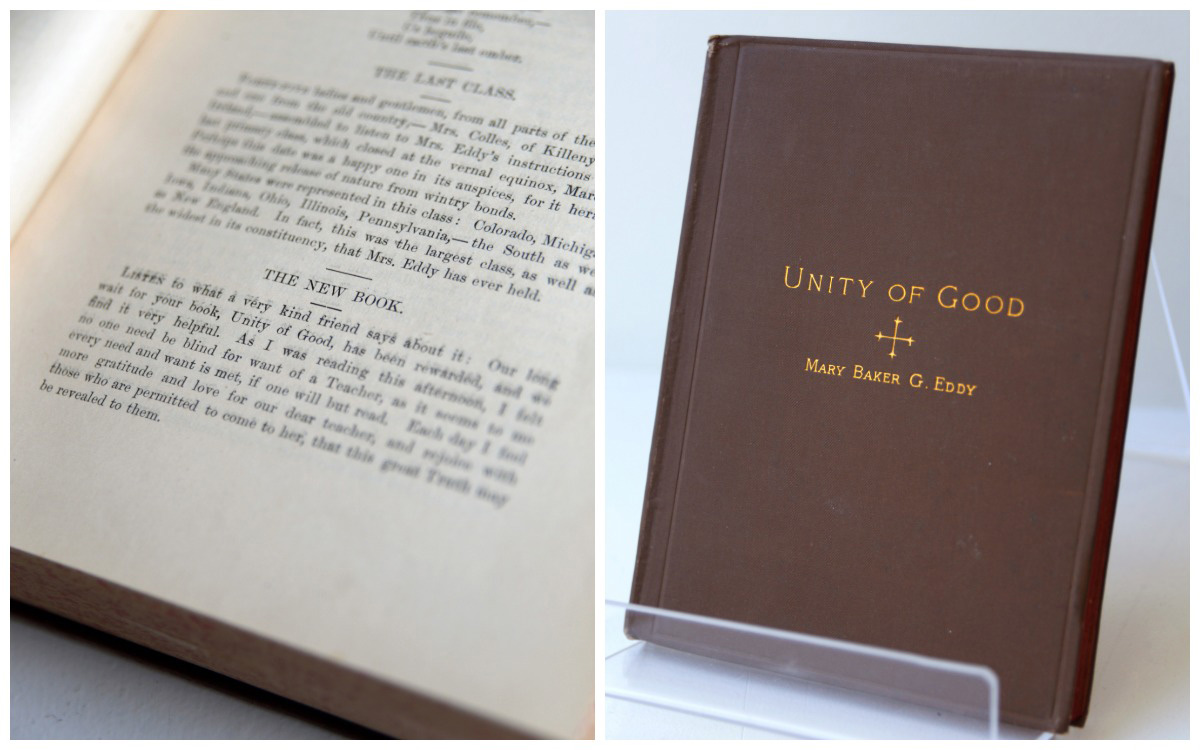
“The New Book,” The Christian Science Journal, April 1888, 51. First edition of Unity of Good and Unreality of Evil by Mary Baker G. Eddy, 1888.
We are sometimes asked about the history of this book by Mary Baker Eddy. The work explores God’s nature as supreme good and shows how an understanding of this enables one to prove evil powerless. Eddy addresses the subject by answering questions, such as “Does God know or behold sin, sickness, and death?” and “Is There no Death?” She also discusses related topics that include “The Saviour’s Mission.”
According to historian Robert Peel, Eddy drew inspiration for Unity of Good from letters she exchanged with William I. Gill (1831–1902). Originally from England, he was the pastor of a Methodist congregation in Lawrence, Massachusetts, when he first became acquainted with Christian Science. He went on to join Eddy’s March 1886 Primary class and served as the assistant pastor for her Church of Christ (Scientist) on a trial basis, as well as the editor of The Christian Science Journal in 1886.
Covered at length in Peel’s Mary Baker Eddy: The Years of Trial,1 their discussions focused on whether God can know evil. In the conclusion of a lengthy letter, Gill wrote to Eddy on November 25, 1886 along these lines:
It is clear that God cannot know (by experience, impression, acquisition) evil; but He must be able to understand it as the logically contrasted opposite of himself, as a falsity, a claim to be what it is not. I have all along thought that this must be what you mean. If it is not, I am in deep distress.2
Eddy responded to Gill the following day:
This law of God is universal infinite and eternal by virtue of God’s Allness and that God cannot know what is outside of Divine knowing namely that there is something beside Him, Good. But His law reaches with its spirit and intelligent working every error supposable because it is the law that defines God as All and that there is none beside Him, hence that there is no error3
She provided further explanation in an article published weeks later in the Journal.
The mythology of evil and mortality is the material mode of a suppositional mind; while the immortal modes of Mind are spiritual, and they pass through none of the changes of matter, or evil. Truth said, said from the beginning, “Let us (Spirit) make man perfect,” and there is no other Maker, and a perfect man would not desire to make himself imperfect. These modes declare the beauty of holiness, and that His manifold wisdom shines through the visible world in glimpses of the eternal verities. Even through the mists of mortality is seen the brightness of His coming.4
Realizing the importance of providing an accessible explanation of these aspects of her teachings, in 1887 Eddy moved forward in working on a volume on the subject—Unity of Good and Unreality of Evil. In his book Twelve Years with Mary Baker Eddy, Irving C. Tomlinson described that work. Though she was teaching at the Massachusetts Metaphysical College, in addition to all of her other responsibilities, Eddy would rise early and dictate Unity of Good to her secretary Calvin Frye, before meeting with her class.5
Eddy copyrighted the book on September 28, 1887. Its publication was announced in the November 1887 Journal and took place in March 1888.6 An editorial published the next month described one individual’s response to the new volume:
Our long wait for your book, Unity of Good, has been rewarded, and we find it very helpful. As I was reading this afternoon, I felt no one need be blind for want of a Teacher, as it seems to me every need and want is met, if one will but read. Each day I feel more gratitude and love for our dear teacher, and rejoice with those who are permitted to come to her, that this great Truth may be revealed to them.7
The book was later retitled Unity of Good and announced under that name in the January 1892 Journal.8
In her correspondence, Eddy shared her thoughts on the importance of this volume. On March 10, 1888—soon after Unity of Good and Unreality of Evil was first published—she wrote to her student Ellen Brown Linscott:
The book Unity of Good was needed or it would never have taken about six months to get that little book published[.] The way is always blockaded in proportion to the weight of good that is to be carried over it you know9
In a 1892 letter to her student Augusta Stetson, Eddy called Science and Health with Key to the Scriptures and Unity of Good “my greatest life work.”10 Later, in a list of her six leading books sent to the editorial offices of the English periodical The Onlooker, she ranked Unity of Good number three, right behind Science and Health and Miscellaneous Writings 1883–1896.11

- See pages 259–282.
- William I. Gill to Mary Baker Eddy, 25 November 1886, IC215.36.025.
- Eddy to Gill, 26 November 1886, L02555.
- Eddy, “Science and Philosophy,” Journal, December 1886, 210. This article was later republished in Eddy’s book Miscellaneous Writings 1883–1896 (Boston: The Christian Science Board of Directors), 359–368.
- Irving Tomlinson, Twelve Years with Mary Baker Eddy, Amplified Edition (Boston: The Christian Science Publishing Society, 1996), 223.
- Assignment of Copyright, 30 December 1909, Subject File, Eddy, Mary Baker – Writings – Copyright, 3. “Unity of Good,” Journal, November 1887, 431; “Mrs. Eddy’s New Book,” Journal, March 1888, 635.
- Editor, “The New Book,” Journal, April 1888, 51.
- Henry M. Baker, Archibald McLellan, and Josiah E. Fernald, assignment of copyright, 6 March 1907, Subject File, Eddy, Mary Baker – Writings – Copyright.
- Eddy to Ellen Brown Linscott, 10 March 1888, L08753.
- Eddy to Augusta E. Stetson, 18 December 1892, H00020.
- Eddy to The Onlooker, c. 1907, L12573. See also Painting a Poem: Mary Baker Eddy and James F. Gilman Illustrate “Christ and Christmas,” (Boston: The Christian Science Publishing Society, 1998), 1.