
From the Collections: Ready in 12 days—the founding of the Christian Science Sentinel

Nameplate and masthead of the first issue of the Christian Science Sentinel to run under the magazine’s new name. When it launched in 1898, the magazine was titled The Christian Science Weekly. Staff photo.
Listen to this article
On August 20, 1898, Mary Baker Eddy wrote to William P. McKenzie, who was then serving as a Trustee of The Christian Science Publishing Society:
The dignity of our cause and the good of students demand of us to publish a weekly newspaper[.] Please name it a little more graphically eg. Christian Science Messenger.1
Background
Two days later, Eddy wrote again to McKenzie—perhaps with a bit of humor. “I hear you all were elated at the order, have a weekly newspaper,” she said.2. Eddy soon appointed Septimus J. Hanna and his wife, Camilla Hanna, as “head” of the publication.3 The first issue listed him as Editor and her as Assistant Editor.
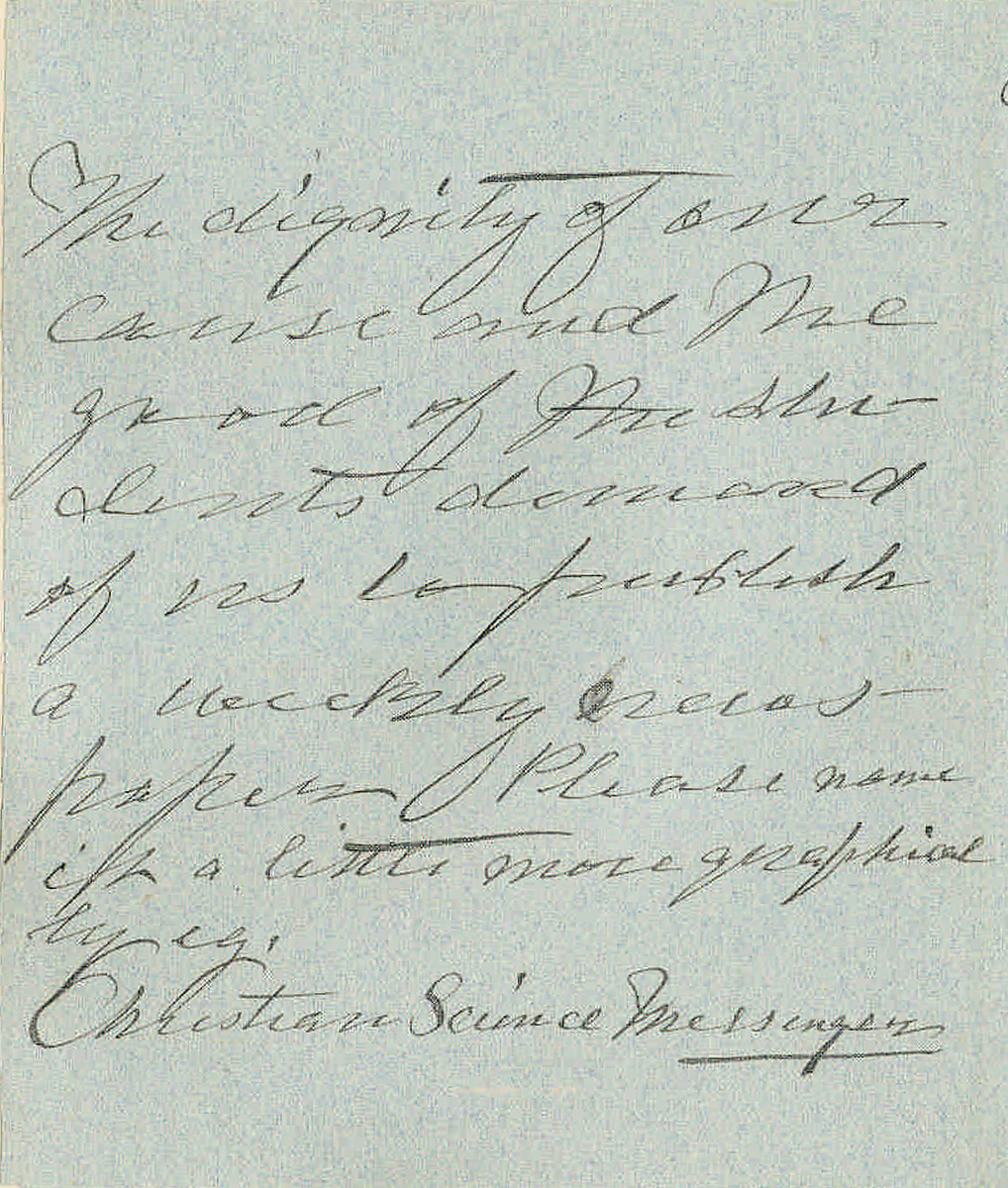
Letter from Mary Baker Eddy to William P. McKenzie, page 2, August 20, 1898. L04871B.
On August 25 Septimus Hanna sent Eddy a sample copy of the new publication for her review.4 The first published issue was dated September 1 and titled The Christian Science Weekly. As one editorial in that first issue stated, the purpose of the Weekly was to serve as a frequent form of communication among Christian Scientists.5 That issue consisted of seven pages of general news items, testimonies of Christian Science healing, and other articles on Christian Science.
The publication’s name was changed to Christian Science Sentinel, beginning with the January 26, 1899 issue. Readers were encouraged to be “sentinels,” or watchers, themselves. This was a call to arms. In Christian Science, “watching” often means vigilantly considering what is spiritually true about oneself and the world. It’s knowing that we are, right now, living “in the secret place of the most High,” as described in Psalm 91. A daily practice of watching means one is mentally and spiritually prepared when problems arise.6
In a 1932 reminiscence Mary Godfrey Parker, an early worker in the Christian Science Publishing Society, described what had gone into publishing the Weekly during what must have been a hectic autumn 1898:
We had our hands full those days, more than we could possibly do. In fact, we never went home without leaving a lot of work undone—it just seemed as if we were never able to catch up. Our day commenced at eight in the morning, as I remember, and continued until five thirty, including Saturdays and holidays, and often we came back after supper and worked until late at night wrapping Sentinels. I know there were times when I did not get home until twelve or one o’clock at night….7
The Sentinel was founded at a time when Eddy was taking steps to formalize the structure of her church and publishing activities. For instance, in 1898 she established the Christian Science Board of Education and the Christian Science Board of Lectureship. She also re-established the Publishing Society in its current form. A weekly publication would allow her to communicate progressive developments such as these in a timely manner. In 1908, Eddy explained fully the purpose of the Sentinel, in the context of the launch of The Christian Science Monitor and following the start of two other periodicals, before and after the Sentinel (in 1883 and 1905):
I have given the name to all the Christian Science periodicals. The first was The Christian Science Journal, designed to put on record the divine Science of Truth; the second I entitled Sentinel, intended to hold guard over Truth, Life, and Love; the third, Der Herold der Christian Science, to proclaim the universal activity and availability of Truth; the next I named Monitor, to spread undivided the Science that operates unspent. The object of the Monitor is to injure no man, but to bless all mankind.8
In time the Sentinel became a mainstay of the Christian Science movement. Because of the magazine’s slim silhouette, pieces were shorter. The Sentinel was easy to carry and inexpensive. It played a central role in both personal sharing and public distribution of lightly-used Christian Science literature through courtesy racks in laundromats, bus and train stations, airports, and many other places.
Varied examples of the value readers and contributing writers have placed on the Sentinel span the decades. One contributor wrote: “The writer from her beginning years in the study of this Science has pored over the Sentinel from cover to cover, weekly. Enlightenment, guidance, unfoldment, healing, and precious hope are engendered by this reading.”9 A British reader who volunteered in a correctional facility wrote:
On my monthly visit to a women’s prison, I offered one of the prisoners a Sentinel containing an interview with an individual who had been healed of drug addiction. The prisoner accepted it eagerly and on my next visit accepted another issue, commenting, “I like these. They make you think. I’ve not done much thinking before.”10
While the editors of the Sentinel contribute regularly to its content, most of the content is submitted by Christian Scientists from around the world.
Design and format

Examples of Sentinel covers over the years. From left to right: First cover of The Christian Science Weekly, 1898; “Lady with a lamp” cover, 1906; Cover with colorful graphics, 1973; Recent cover, 2025.
Many changes to the cover of the Sentinel were made during Eddy’s lifetime. One of the most visible was initiated in July 1906, when she wrote a suggestion on an advance copy:
What if you put here the figure of a woman with a lamp in her hand. This would illustrate Longfellows lines in verse [from his poem Santa Filomena]….11
Starting with the September 1, 1906, issue, two such figures appeared on the cover. Underneath each figure were verses from Santa Filomena, an 1857 poem by Henry Wadsworth Longfellow. He had written it in admiration for Florence Nightingale, known to carry a lamp to cheer up and support patients in uncomfortable field hospitals during wartime.12
In subsequent years, minor design changes were made to the Sentinel’s cover. But the two figures of women remained in their prominent position for 51 years. On July 20, 1957, one figure was dropped. The remaining one was moved to a place inside the publication 10 years later, beginning with the April 2, 1966 issue. At that time, the cover was completely overhauled with a contemporary design. In 1973, the figure was removed entirely.
Starting that same year, Sentinel covers regularly featured photos or geometric designs. An announcement from the Publishing Society’s Board of Trustees explained the change:
After careful review of good contemporary design practices, we believe the time has come to remove the remaining lady with a lamp and to update the cover to keep the Sentinel “abreast of the times”—as did Mrs. Eddy. These changes will be effective with the issue of April 7.13
Indeed, the year 1973 was significant. That was when construction was largely completed on the new Christian Science Center. That year at the Annual Meeting of The Mother Church, reports from officers highlighted the years-long project as seminal in supporting the worldwide growth of healing through Christian Science. The Trustees related it to the Church’s religious publications:
This past year has seen a great stirring of mankind with wars, terrorism, racial and economic uncertainties, and a questioning of moral standards. This surfacing of problems has posed both a challenge and an opportunity for the Editors of our periodicals. It has prompted us all to carefully examine each product to be sure we are keeping abreast of changing times but at the same time carefully adhering to the standards set down by our Leader.… The Christian Science Journal, Sentinel, and Herald, in their attractive new colors and designs, are reaching people in families, communities, and areas we have never before been able to get to….14
Answering the needs of the world
Another important waymark for the Sentinel took shape after the 9/11 attacks in 2001. Within the space of about 72 hours, an entirely new edition, which immediately responded to the tragedy, was written and sent for publication.15 This development afforded a fresh look at how the magazine was fulfilling Eddy’s intention for it, seeking out and ministering to the people and places everywhere in need of her discovery—which she understood to be the healing Comforter that Jesus promised would live with humanity and “teach you all things.”16 As staff members saw the urgent needs of that moment, they identified ways to respond to them—calling on the Christian Science field and giving voice to its members’ prayerful insights and the practical actions they gave rise to. In this way the vision was significantly renewed for what was possible for the Sentinel. It marked a watershed moment for the publication, from which it would not turn back.
The introduction of digital formats
In the continuing effort to better meet humanity’s needs, a major innovation affecting all the Christian Science magazines, including the Sentinel, was introduced to readers of the March 2011 Christian Science Journal. In an unassuming article titled “Next Tuesday, a Year from Now,” members of the Christian Science Board of Directors and the Trustees explained how they were exploring the use of digital formats. They wrote in part:
Clearly, the only reason our magazines exist is to help spiritually-minded people better understand and put into practice the healing power of Christian Science. We think a great deal about the demand Mary Baker Eddy placed on her Church’s magazines to be “ably edited” and to be “kept abreast of the times.” Again and again, we find ourselves asking, “What are the needs of our readers today?”17
The final form of an electronic platform was still being determined, which would eventually become JSH-Online, and in this article the authors asked for reader input and ideas. Hosting the Sentinel (as well as the church’s other religious magazines) in a digital format would be a major shift; a subsequent article by managing publisher John Sparkman reassured readers that print versions of the publications would continue.18
The official launch of the Sentinel website (as part of JSH-Online) in April 2012 provided something momentous: for the first time, readers had digital access to the full collection of content since the Sentinel’s 1898 beginnings. Previously, those wishing to search for past content had to make use of a privately developed computerized indexing tool and/or consult hard copies to read the full content. This process was becoming increasingly out of sync with how many people accessed information. Now subscribers could immediately access the Sentinel anywhere they had an internet connection, and make use of advanced search capabilities for both print and audio materials, including in the original context. Sharing via social media and email was also seamless. Later updates to the website added the ability to listen to a recording of every newly-published article, usually in the voice of its author.
A major redesign
In February 2020, Marla Sammuli, then product manager for the Journal, the Sentinel, and The Herald of Christian Science, wrote about format and publishing changes underway at the Sentinel. She referred to the aforementioned 1899 announcement that highlighted the role of readers as “sentinels,” or watchers, and then drew a connection between active watching and active use of the magazine. She announced updates that included a redesign of both the online and print versions of the Sentinel. And she spoke of “an opportunity” for readers “that begins in our lives, with our daily practice of watching, and then naturally spills into the pages and webpages of this magazine—in ways that meet the unique demands of today.”19 The digital version was refreshed with an updated presentation. And starting with the January 4, 2021, issue, the print version now had an inviting and accessible format, with the table of contents and editorial starting right on the front cover. QR codes inside the print edition linked to online-only content.
“Timely and relevant”
In the fall of 2025, the Trustees announced further updates to the Sentinel, intended “to rejuvenate, deepen, and broaden our individual practice of Christian Science and to foster a deeper sense of connection with The Mother Church.”20 Editors continue striving to be even more relevant, timely, and accessible as they deliver on the mission “to hold guard over Truth, Life, and Love.” The article began, “our Church’s periodicals represent a covenant between Christian Scientists of today and the discovery found in the textbook of Christian Science…. Through the pages of these magazines, we are recording our collective demonstration of the power of God’s Word as found in the Bible and our textbook.”21
Readers learned about a number of new initiatives designed to “foster a rich sense of community” around readership of both the Sentinel and Journal as “organs of this church.”22 This includes streamlined subscription capabilities and less lead-time in content publication, which in turn facilitates more timely responses to subjects in current world thought. Along these lines, Sentinel issues are now published online as soon as they are compiled; print versions ship at the same time that new issues appear on JSH-Online. Whereas issues were previously curated far in advance of publication, the new method makes print and digital issues available as soon as they are ready, with the online availability allowing all subscribers around the world to access each new issue at the same time.
Each issue of the Sentinel now organizes content in sections, making the relevance of each piece more apparent. Creating more robust section-based organization on the website—such as “Praying for the World” and “Spiritual Journeys”—invites online readers to browse and explore multiple articles related to a relevant theme.
In this way, the Publishing Society continues to update its presentation of the Sentinel in order to best meet contemporary needs, working within a rapidly shifting technology and publishing landscape. “These periodicals,” noted the Trustees, “should be the first place members and subscribers can visit to find out what’s going on with The Mother Church and its worldwide branches and societies.”23

- Mary Baker Eddy to William P. McKenzie, 20 August 1898, L04871B. It appears Eddy was considering a weekly publication as early as June 1898. See Eddy to Septimus J. Hanna, 22 June 1898, L05226.
- Eddy to McKenzie, 22 August 1898, L04872.
- Eddy to Septimus J. Hanna, 23 August 1898, L05228. The Hannas were already editors for the church’s monthly periodical, The Christian Science Journal.
- Septimus J. Hanna to Eddy, 25 August 1898, 033bP2.13.013.
- See “Salutatory,” The Christian Science Weekly, 1 September 1898, 1.
- See “Our Third Bow,” Christian Science Sentinel, 26 January 1899, 4.
- Mary Godfrey Parker, “Reminiscences of Mrs. Mary Godfrey Parker,” 13 December 1932, Reminiscence, 35–36.
- Eddy, “Something in a Name,” The First Church of Christ, Scientist, and Miscellany (Boston: The Christian Science Board of Directors), 353.
- Gladys C. Girard, “How a Sentinel Became a Missionary,” Journal, October 1975, 520.
- “You, your community, and the message of Christian Science,” Journal, October 1991, 17–20.
- Eddy to McLellan, July 1906, L03117.
- Eddy also greatly admired Nightingale, recognizing her work in Science and Health with Key to the Scriptures (see page 385).
- Board of Trustees, The Christian Science Publishing Society, “Announcement,” Sentinel, 31 March 1973, 560.
- “Annual Meeting of The Mother Church,” Journal, August 1973, 464.
- For more on changes following 9/11, see the Library’s website article “How did The Mother Church respond to the 9/11 attacks?”
- See John 14:26, and Eddy, Science and Health with Key to the Scriptures (Boston: The Christian Science Board of Directors), 55.
- Mary Trammell, Michael Pabst, Scott Preller, Judy Wolff, “Next Tuesday, a Year from Now,” Journal, March 2011, 18.
- See John Sparkman, “JSH-Online—Looking Under the Hood,” Journal, October 2011, 21.
- See Marla Sammuli, “You are a sentinel,” Sentinel, 3 February 2020, 2.
- The Christian Science Publishing Society Board of Trustees, “Keeping our periodicals timely and relevant,” Sentinel, 20 October 2025, 4.
- Trustees, “Keeping our periodicals timely and relevant,” Sentinel, 4.
- See Eddy, Church Manual (Boston: The Christian Science Board of Directors), 44.
- Trustees, “Keeping our periodicals timely and relevant,” Sentinel, 4.