
How did Christian Scientists respond to the 1917 Halifax disaster?
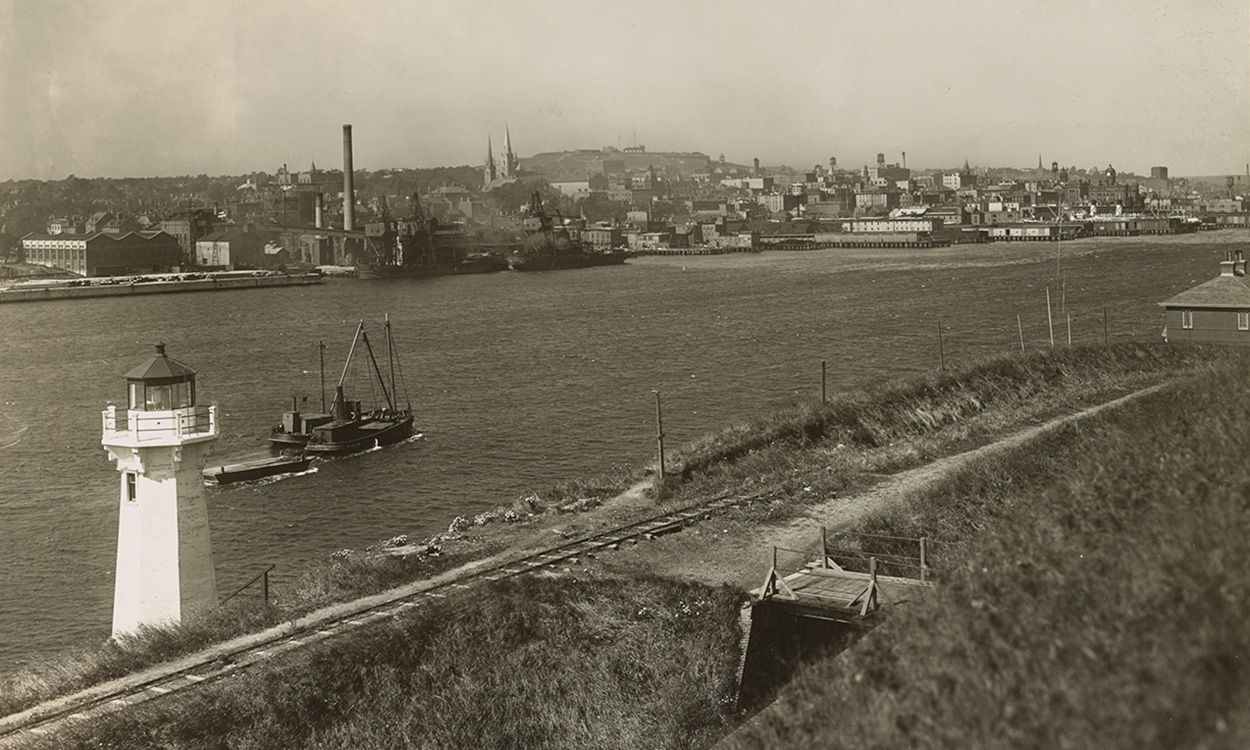
Lighthouse and boat on water, Halifax, Nova Scotia, 1917. Courtesy of Library of Congress, Prints & Photographs Division, LC-DIG-ds-05402.
On December 6, 1917, two steamships collided in the harbor off Halifax, Nova Scotia, setting off what the Nova Scotia Archives calls “the worst man-made disaster in the world’s history.”1 This was at the height of World War I; the French ship Mont Blanc was loaded with explosives and the Norwegian vessel Imo was carrying relief supplies.2 Halifax was in urgent need of help; radiating out from the harbor, the explosion had impacted adjacent areas of the city, claiming some 2,800 lives and causing widespread destruction.
From its Boston location, The Mother Church (The First Church of Christ, Scientist) joined other organizations in responding rapidly. Hearing of the news, the Christian Science Board of Directors quickly appointed a five-member relief committee.3 Its first order of business was to organize a relief train that could immediately make a journey of 700 railroad miles, while also negotiating a severe early-winter snowstorm.4 Although it was the third train out, The Mother Church’s would be the first to reach the people of Halifax.5
The city of Boston had not been successful in its own efforts to organize a special train, something especially difficult to do at the time.6 Together with the Red Cross, city officials asked for room on The Mother Church’s train, which the Directors had financed through the Boston & Maine Railroad. The Church quickly agreed. A group of 30-to-40 Red Cross workers, doctors, surgeons, and nurses, as well as relatives of victims, was welcomed on board, allowing them to reach Halifax a day earlier than otherwise possible.7
Organizing a train was not the only form of aid. On December 29, 1917, The Christian Science Monitor reported on additional efforts of Christian Scientists in coming to the aid of Halifax:
Meanwhile, in Boston, special arrangements were made for special collections in The Mother church, and also in many of the branch churches in other cities, and the Comforts Forwarding Committee to charge of the gathering of clothing and supplies, and the forwarding of them to Halifax.
Besides $10,000 in cash and letters of credit [about $253,100 in 2025 currency], the representatives of the Board of Directors took first aid in the form of warm clothing, food, and other necessary articles to be distributed among the sufferers at Halifax.
On board the special train, as representatives of the Board of Directors were: Ralph E. Parker, Mrs. Edith W. Parker, Charles H. Welch, William Bradford Turner, R. Howard Cooley, and Dr. Frank Colby….
The special collection taken at the services in The Mother Church on Sunday [December 9], which is but a preliminary one, as not proper notice had been given, amounted to $4,693.04 [about $118,800 in 2025 currency]. Also, if further relief is necessary, the Directors are prepared to send nurses, etc. Collections taken in Christian Science branch churches are yet to be reported and made available.8
The 1922 book Christian Science War Time Activities: A Report to The Board of Directors of The Mother Church by The Christian Science War Relief Committee describes the train’s departure:
Large supplies of clothing were quickly gathered and placed on the train, and at 7.30 p.m., Saturday, December 8, the Committee left Boston in a terrific snowstorm, “to go,” as one member said with uplifted thought, “not to a city of disaster, but to a city whose builder and maker is God [see Heb. 11:10], a city of harmony, in the ever-present kingdom of heaven.”9
While two previous trains had been held up for hours in Truro, Nova Scotia—60 miles from Halifax—the Church’s train “remained in Truro but ten minutes.” And while the delegation was told that it would not be allowed to travel any closer to the center of the city than five miles, this did not prove to be the case:
Again, God’s power was relied upon, and the following morning, Monday, December 10, upon rising the Committee found themselves in the heart of the city, their train having been the first to pass under a badly burned bridge and through the devastated region.”10
Stepping off the train around 7:00 a.m., the delegates took clothing and supplies to a central facility at the Masonic hall. In the coming days, the relief workers from the Church worked there to help make distributions, as well as to directly buy from local stores the special clothing and other items that were needed in a hurry. They also organized a Halifax Relief Fund that aided people, regardless of religious creed, which was of special help in situations where public funds could not be used.11
In a 1998 article, The Christian Science Journal quoted Halifax resident Nora Myers, whose grandfather had been killed in the explosion before she was born:
“Imagine,” she said, “if you had been in Boston just nineteen days before Christmas and, as a member of The Mother Church, you had been asked to go to another country with relief supplies and live amidst that devastation for a while. They just went! That touches me deeply. What an outpouring of brotherly and sisterly love it was! On that venture there was no barrier of race, color, or creed, and no shrinking back from what they saw there.
“Over the years I’ve thought about that train so often. Trains looked different in those days—they were big and strong and black. But I think of that particular train shining like a shield of salvation [see Ps. 18:35]. Church workers from many different denominations pitched in, but I am especially touched by the thought that members of my Church were first on the scene. And the shield they brought comforted and healed so many people.”12
Along these lines, one prominent Halifax official wrote this to The Mother Church:
No words of mine can express to you, your party, and your Church, the thanks of Halifax for the promptness with which you arrived on the scene, the goods you brought with you, and last but not least, the sympathy you showed and the willingness with which you undertook any work that came first to your hand.13
The Mother Church joined many other organizations, in Boston and far beyond, in responding with aid and comfort to the people of Halifax. In December 1918 Haligonians sent the city of Boston a large Christmas tree, as a symbol of friendship and thanks for its relief efforts in the wake of the disaster. Halifax offered this gift to the city again in 1971, and the tradition has continued every year since.

- “1917 Halifax Explosion,” Nova Scotia Archives website, https://archives.novascotia.ca/virtual/?Search=THexp&List=all, accessed 9 October 2025.
- “Halifax Explosion News Still Scanty,” The Christian Science Monitor, 7 December 1917, 1.
- “Remembering Halifax at Christmas,” The Christian Science Journal, December 1998, 31.
- W. J. Hayes, “The 1917 Halifax Explosion and Boston’s Response,” 6 December 2017, https://fermentingpolitics.wordpress.com/2017/12/06/the-1917-halifax-explosion-and-bostons-response/#:~:text=The%20fact%20the%20train%20made,answered%20the%20call%20in%201917, accessed 8 October 2025.
- “Remembering Halifax at Christmas,” Journal, 31.
- “Strange Bedfellows,” News Tribune (Duluth, Minnesota), 20 December 1917.
- Christian Science War Time Activities: A Report to The Board of Directors of The Mother Church by The Christian Science War Relief Committee (Boston: The Christian Science Publishing Society, 1922), 61–62.
- “Speedy action was taken by the Christian Science Organization,” Christian Science Sentinel, 29 December 1917, 349.
- Christian Science War Time Activities, 61.
- Christian Science War Time Activities, 62–63.
- Christian Science War Time Activities, 63–64.
- “Remembering Halifax at Christmas,” Journal, 31.
- Christian Science War Time Activities, 65.