
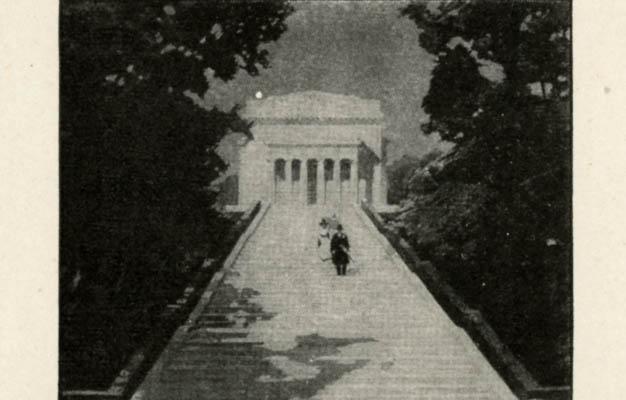
Photo from fundraising flyer for “Lincoln Memorial Hall,” c. 1909. Clarence H. MacKay to Mary Baker Eddy, 8 February 1909. 690a.79.014.
Mary Baker Eddy was a great admirer of Abraham Lincoln, as were so many of her American contemporaries. So it’s hardly surprising that as the 1909 centennial of Lincoln’s birth approached, special celebrations and commemorations were planned throughout the United States. In more recent times, perhaps the best known of these commemorations has been the Lincoln one-cent coin.
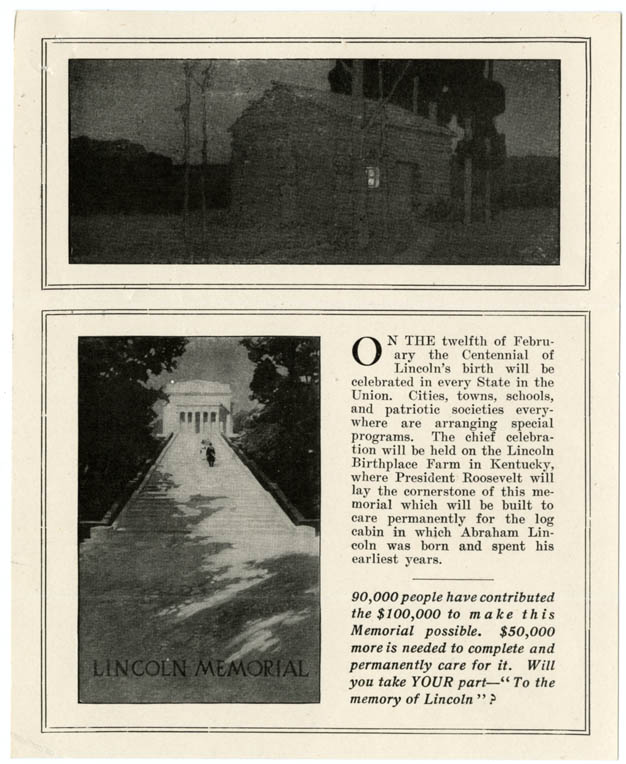 Another enduring monument to the sixteenth president is the farm where Lincoln was born, which is now the Abraham Lincoln Birthplace National Historical Park in Hodgenville, Kentucky. In 1906 the Lincoln Farm Association was founded, to preserve this “birthplace farm” and create a proper memorial. This was to be a “Lincoln Memorial Hall” that housed a log cabin, constructed with timbers thought to be from the Lincoln birthplace. (The logs were later found to have no Lincoln connection.) The hall is an imposing building, designed by John Russell Pope, later architect of the Jefferson Memorial in Washington, DC. The cornerstone of that hall was laid on February 12, 1909—the anniversary of the Lincoln centennial.
Shortly before the cornerstone ceremony, Eddy received a flyer on the monument (pictured left) from Clarence H. MacKay, Treasurer of the Association, providing illustrations of the planned buildings. “We ask that you will help us,” he urged, “to complete and pass down to your children and ours a memorial worthy of our great President. It is more than our duty; it should be to us a sacred privilege.”1
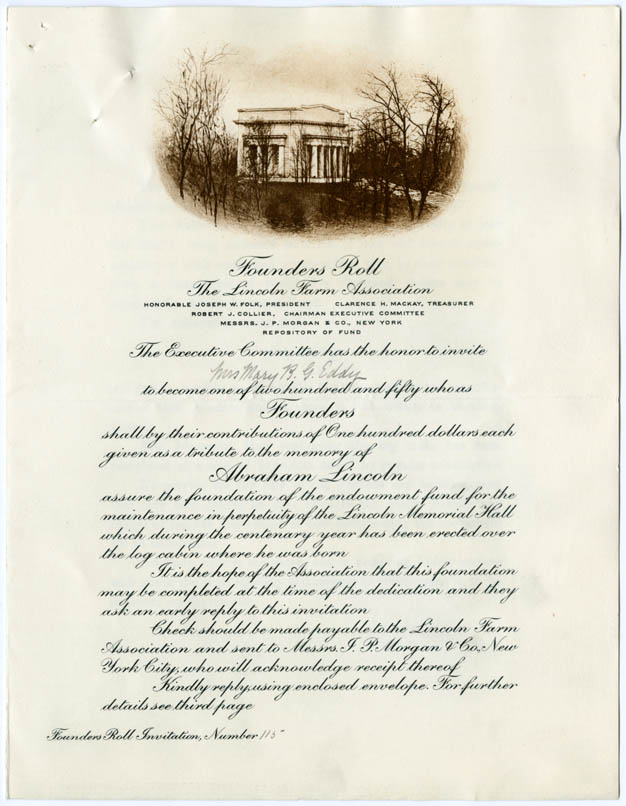 Early in 1910, Eddy was again contacted—as one of 250 distinguished Americans invited to donate to, and be designated as “Founders” of, the Lincoln Farm Association. The list included such other dignitaries as Mrs. Marshall Field, Mark Twain, and Cardinal James Gibbons. Eddy sent her contribution to the monument in May 1910. However, the park was not completed until late in 1911, about a year after her passing. A short while later, the Association donated the property to the Commonwealth of Kentucky, which in 1916 gave the park to the federal government. Today the site is preserved as a location where the public can learn more about the life and achievements of Abraham Lincoln.