
Mary Baker Eddy’s response to weather and climate
By Stephen Graham, The Mary Baker Eddy Library
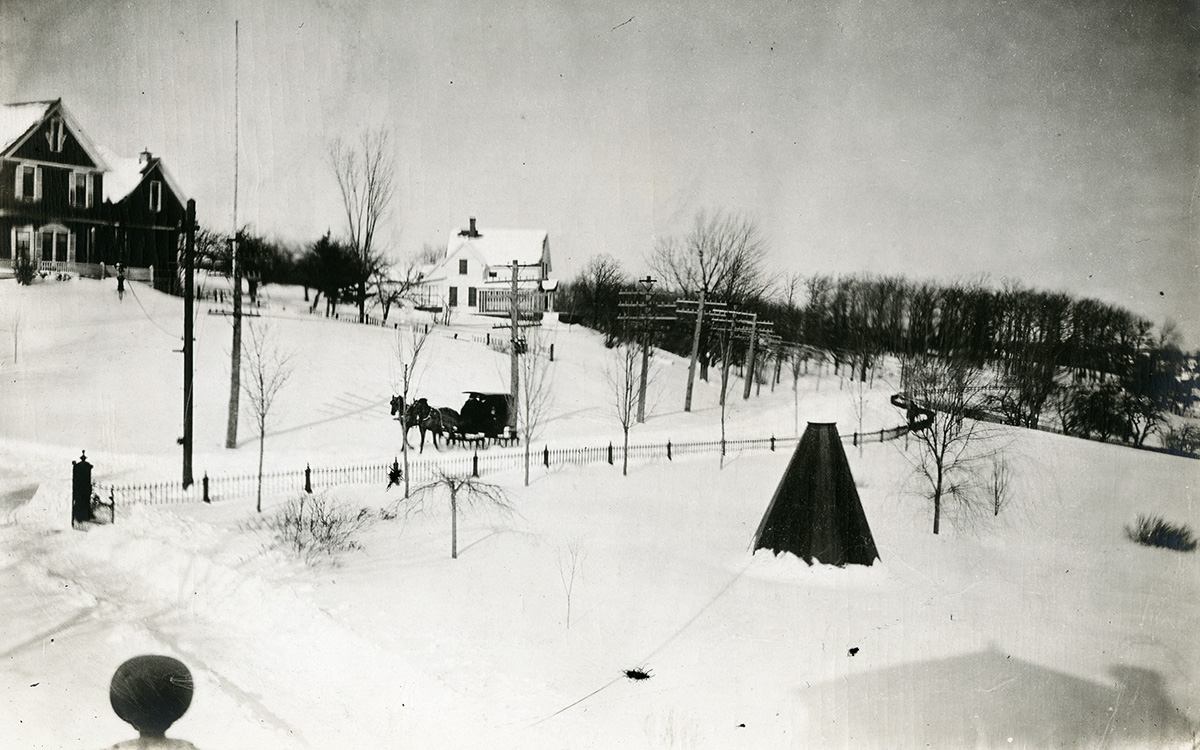
Winter photo taken from Mary Baker Eddy’s home in Concord, New Hampshire, n.d. P06550.
This paper was presented on August 20, 2024, at the twenty-first annual conference of the European Association for the Study of Religions (EASR), in Gothenburg, Sweden. The topic of the conference was “Nature, Ecology, and Religious Responses to Climate Change.”
I’m delighted to be here today! This paper is titled “Mary Baker Eddy’s response to weather and climate.”
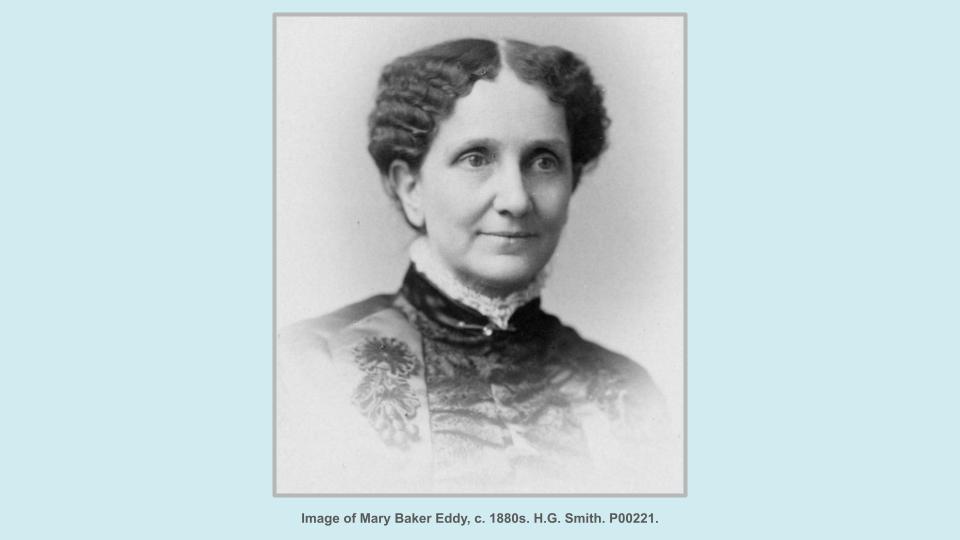
For those of you who may not know, Mary Baker Eddy founded the Christian Science church in the late nineteenth century (which by the way has no connection with the Church of Scientology). I’ll be talking more about her biography soon.
There are three main points I would like to convey to you today:
- Mary Baker Eddy believed there is a connection between metaphysical reasoning and the improvement of the physical world.
- She felt that prayer could be undertaken with scientific results.
- She saw a role for individual and collective action in confronting environmental threats from a spiritual perspective.
To begin: a case study
On a frigid January day in the late 1890s, a farmer in the American state of New Hampshire was in a desperate situation. Amid the brutal cold, his well had gone dry. His cows were stopping their production of milk, and he was struggling to melt enough ice and snow to provide them with water to sustain them.
Mary Baker Eddy, the founder of Christian Science, heard about this. That man was a neighbor who sold milk to Eddy, and she no doubt wanted to help him. But her solution had nothing to do with a change in the weather or the melting of ice. In response to that farmer’s dire circumstances, she simply remarked, with a smile, “Oh! If he only knew…. Love fills that well.”1
By Love, Eddy—now a woman with considerable national fame as a religious leader—was not referring to a mere emotion. Nor was she trivializing a dangerous situation. Rather, a lifetime of prayer and scriptural study lay behind her concept of the term Love. In her estimation, Love was synonymous with God.2
Clara Shannon, the woman who had alerted Eddy to that farmer’s situation, noted a number of instances in which she had seen Eddy pray about the environment, with noticeably beneficial results. In a reminiscence published in 1927, she described what followed for that farmer:
The next morning, when the farmer brought the milk, he was overjoyed…. That morning early when he had gone out to attend to the cattle, he found the well full of water, and in spite of the bitter, cold day with all the ice and snow round, the well was full of water. He said it must have been Mrs. Eddy’s prayers that had done it all. She must have had something to do with it for it was a miracle. He had a great reverence for Mrs. Eddy although he was not a [Christian] Scientist.3
Eddy was convinced that no adverse physical circumstance could be beyond a metaphysical solution. While Christian Science is primarily known for its claims to heal people of disease, she saw its practice as addressing the full range of humanity’s needs, both acute and chronic. Ultimately, she believed, reliable solutions to world problems lay in the metaphysical realm. In other words, she felt that the perception of spiritual truth, in her own words, “determines the outward and actual.”4
To put it another way, on that day in New Hampshire, the farmer and Eddy’s aide Clara Shannon believed that her acknowledgement of God as omnipresent Love exemplified a type of the prayer that Eddy had come to expect would reliably produce a harmonizing effect, commensurate with the immediate need.
Biography and background
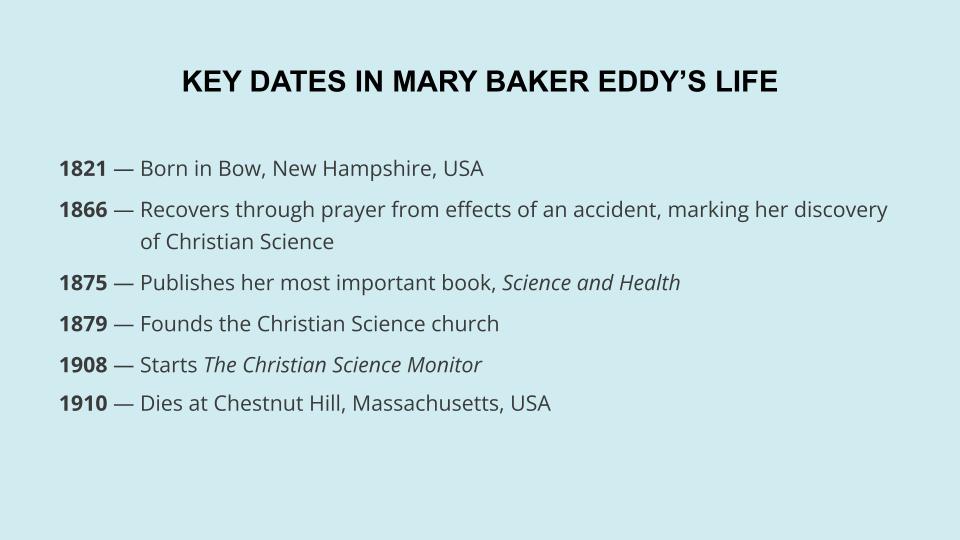
Born in New England in 1821, Eddy grew up in a devout Christian family, attending the Congregational church, where the Bible was central to daily living. Chronic ill health, widowhood, and poverty eventually brought her to her own desperate state. On February 1, 1866, at the age of 44, she sustained critical injuries after falling on the ice, and was thought to be dying. It was then that prior decades of searching for both medical and spiritual solutions culminated in a sudden recovery from those injuries, which appeared miraculous to those around her. It occurred when she turned to the Bible and read one of Jesus’ healings.5
Three years followed in which she studied scripture and sought to better understand and articulate what had healed her. She came to identify divine laws that underlay the healings of Jesus and his followers, and sometimes referred to them as “scientific,” in that when she applied them consistently, the results were predictable. She also felt confident that she could teach her method to others and that they could heal in the same way.6
In 1875 she published a textbook to explain Christian Science—Science and Health with Key to the Scriptures—devoting the following three decades to establishing a church, which slowly expanded around the world. At the time of her death in 1910, she was one of America’s best-known women.
A benchmark
Above all else, Eddy expected those studying Christian Science to be animated, engaged healers, in the broadest sense of the term. For her, this involved caring for and benefitting the whole planet.7 According to Stephen Gottschalk, a historian of American religion, “the purpose of the church that Eddy and her students founded in 1879 was to restore ‘the marvelous healing power of goodness’ to contemporary Christianity.” He went on to provide this context:
To revive the warmth and power of early Christianity was the motive of other American religious denominations as well—the way in which many Protestant groups defined their animating purpose. To the founders of the Disciples of Christ, this meant restoring the patterns of worship in the early church. To Baptists, it meant a return to the unchallenged authority of the Bible and the baptism of believers. To Methodists, it meant a fresh emphasis on the role of love in Christian life, the recovery of “living powers of refreshment” of apostolic Christianity. To Pentecostals at the beginning of the twentieth century, it meant the fresh outpouring of the Holy Spirit, including speaking in tongues, that marked the Day of Pentecost and the revival of apostolic healing as well.
“Yet,” Gottschalk concluded, “none of these denominations took the healing work of the early church as their benchmark indication of the primitive Christianity that needed to be restored.”8
Contemporary relevance
So—what might Eddy have said about the current fear of a climate crisis, in terms of healing? How could her teachings address, in a practical way, the ominous effects of rising ocean temperatures and sea levels? The shrinking polar ice caps? An increase in heat waves, floods, and hurricanes? What do Christian Scientists believe that their religion offers in terms of a valid response to today’s complex atmospheric and geopolitical questions?
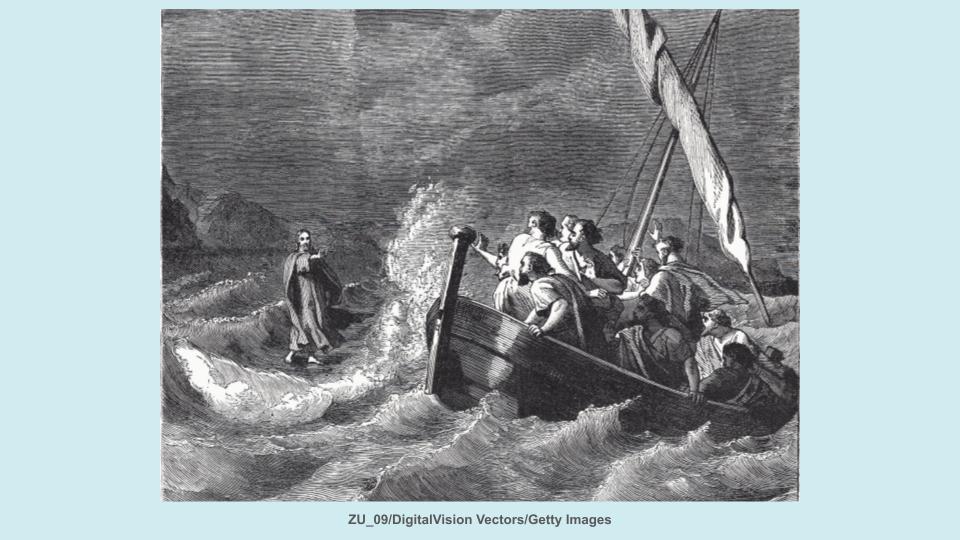
Eddy’s convictions regarding God, prayer, weather, and climate grew out of her Christianity. As a student of the Bible, she had read in the Hebrew Scriptures the accounts of prophetic appeals to God in times of famine. She knew well the old testament stories of Moses finding life-sustaining water in the desert and Elijah successfully praying for rain in drought.9 And she made repeated reference to Christ stilling a storm on the Sea of Galilee.10 Unlike some others, however, Eddy came to believe that these incidents were neither miraculous nor confined to the past. Instead, she classified them as examples of a divine law in operation on earth, overruling the laws of nature and physics.
She was once quoted as saying, “The weather expresses our concept of it and can be handled as any claim if you do not hold it as something apart from you, governed by some other power or almanac. God governs all. This is the way Jesus stilled the tempest.”11 For Eddy, every trustworthy improvement in the human condition, no matter how big or small, had to begin with a transformation of thought, outlook, perspective, and must be impelled by a force beyond that of human intelligence alone. She revered good education and placed a premium on sound reasoning, once referring to reason as “the most active human faculty.”12 But she subordinated human intelligence to an enlightenment independent of the brain—to each individual’s direct spiritual expression of what she termed “the divine Mind,” another name she identified for God.13 This is grounded in her interpretation of us as children of God created in God’s image, as noted in Genesis 1.14
Many people and religions would acknowledge the helpful part that inspiration can play in surmounting adversity and even changing things for the better. Yet Eddy pushed further. She saw a direct connection between thought and experience that ultimately, step by step, would be found to be unlimited by threatening physical forces. And she was convinced, based on the biblical assertion that “with God all things are possible,”15 that this was provable.
Irving C. Tomlinson was a former Universalist pastor. He studied Christian Science with Eddy and worked on her staff for a number of years. He described her approach to the weather this way:
Mrs. Eddy taught us that weather conditions are not beyond God’s control, and that they can be corrected through right prayer. She made it clear that Christian Scientists are not to attempt to control or govern the weather. We should know that God governs the weather and no other influence can be brought to bear on it. She said we are to be particularly watchful to guard against any disastrous effects of storms.16
While Eddy felt that God governs weather, she never claimed that God sends evil or destruction. But would she have expected that people could help to mitigate the effects of something as monumental as today’s climate fears by centering their thoughts on God? Simply put, yes, and that internal reorientation was meant to produce external change. She did not present Christian Science as something intended for mere personal comfort, or to be practiced with selfish or exploitative motives. Regarding debate over the humanist and post-humanist motivations for intervening in climate change,17 I think she would have stressed as of great importance a sincere concern for the greater good, marked by the honest love of neighbor and a deep respect for the welfare of the world’s flora and fauna, and beyond. Eddy thought expansively about the planet and believed it held important lessons.
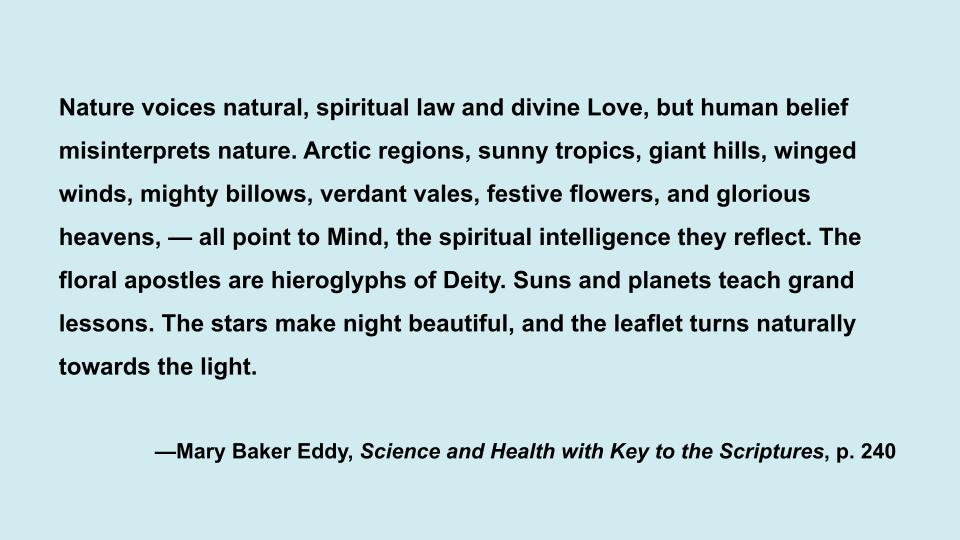
“Nature voices natural, spiritual law and divine Love, but human belief misinterprets nature,” she wrote. “Arctic regions, sunny tropics, giant hills, winged winds, mighty billows, verdant vales, festive flowers, and glorious heavens, — all point to Mind [another term for God], the spiritual intelligence they reflect. The floral apostles are hieroglyphs of Deity. Suns and planets teach grand lessons. The stars make night beautiful, and the leaflet turns naturally towards the light.”18
The nature of creation
This call to view the earth metaphysically acknowledges the nature of God’s creation as she understood the Bible to present it—a pursuit of evidence that, in the words of Genesis, “God saw everything that he had made, and indeed, it was very good.”19
Eddy would not have seen a climate crisis as God’s punishment for humankind’s exploitation. Christian Science does not include concepts of cataclysmic world annihilation or Armageddon. She might find some places of agreement with views like those of constructive theologians such as Catherine Keller, having made statements like this one in Science and Health: “No final judgment awaits mortals, for the judgment-day of wisdom comes hourly and continually, even the judgment by which mortal man is divested of all material error. As for spiritual error there is none.”20 She firmly believed that sinful or mistaken behavior must be exposed, atoned for, redeemed. But in terms of eschatology, her theology is devoid of a wrathful deity who visits punishment on humans for destructive or sinful behavior.
The atmosphere of thought
Eddy felt that everyone—not just Christian Scientists—could, must, improve their mental environment continually, and that this would in turn lead to improvement of the physical environment. She placed great emphasis on watching the condition and quality of thoughts and actions. Harmful, destructive, or disruptive motivations, she maintained, must be redeemed through a clearer understanding of divine truth. In this way, she saw each individual as privileged to play a meaningful part in solving world problems rather than becoming overwhelmed by their immensity.
Christian Scientists have sometimes distinguished themselves in careers in the natural sciences, and she would have respected and valued the best motivations of any scientist or theologian—including the attendees at this conference—as compatible with her humanitarian approach.
Eddy’s correspondence is held in the collections of The Mary Baker Eddy Library in Boston, Massachusetts. Those papers, and her other writings, indicate that she felt destructive climatological forces were amenable to prayer-based improvement. In November 1900, a statement she made appeared in The Boston Globe newspaper. It concluded, “…the atmosphere of the human mind, when cleansed of self and permeated with divine Love, will reflect its subjective state in clearer skies, less thunder bolts, tornadoes and extremes of heat and cold.”21
A values approach to solutions
One of Eddy’s last major initiatives was to found an international newspaper in 1908—The Christian Science Monitor. She gave it the mission “to injure no man, but to bless all mankind” and “to spread undivided the Science that operates unspent.”22 She intended the Monitor to be a real, public-facing newspaper, and, through factual reporting and unbiased analysis, to promote clear, prayerful, solution-oriented thinking. When it began publishing in 1908, the Monitor’s first editor-in-chief described its journalism as an “appeal to good men and women everywhere who are interested in the betterment of all human conditions and the moral and spiritual advancement of the race.”23 Eddy saw the Monitor as one of her church’s greatest gifts to solving problems on a global scale. In the words of biographer Robert Peel, “Ideally, no aspect of the human scene was beyond its healing scope.”24 To date, the Monitor has won a number of Pulitzer Prizes. The debate on climate change has been receiving ongoing coverage. In addition to political activism, the Monitor has been highlighting stories of how young people worldwide have been shaping a new mindset in finding solutions to what they may see as a climate crisis.25
In a recent Zoom interview, Editor Mark Sappenfield26 told me how the Monitor notes a tendency of most climate coverage to be either alarmist or conspiratorial, and in response they attempt to invite all sides into conversation, by identifying common values and mutual understanding as representing the best path forward for change. Rather than fueling fear-based motivations, they are seeking to engage a critical mass of readers to identify new thinking and innovation, in which answers emerge.
“If God endowed us with intelligence,” Sappenfield told me, “then no problem should be larger than God’s ability to fix it and our ability to reflect God’s intelligence. We looked where these qualities were being expressed all around the world. There is no place where they aren’t being expressed, and this is where the answers will come from.” He sees progress as not first and foremost a matter of technology, but rather of focusing on and magnifying the values that drive people and nations forward, including compassion, cooperation, equality, hope, resilience, respect, responsibility, safety, transformation, and trust.
Conclusion
Mary Baker Eddy lived in a time when scientific discovery and industrialization were working monumental change, across a planet, telescoping the limits of time and space. She sometimes saw these as advancements, as evidence of humanity progressing from the material to the spiritual. At other times she cautioned against emerging materialism. She felt that the answers to humanity’s problems, including complex world crises, would emanate from a clearer understanding of a good and omnipotent creator. Against the backdrop of this assertion, I do not think she would have been reluctant to encourage people to pray, and take resultant action, in response to climate fears—with the expectation that this would have immediate and long-term beneficial effects.
Stephen Graham is Senior Manager of Programs and Communications at The Mary Baker Eddy Library.
Slide deck
Presented at the University of Gothenburg, Sweden, August 20, 2024.

- Clara Shannon, “Golden Memories,” 1927, Reminiscence, 32–33.
- See for example Mary Baker Eddy, Science and Health with Key to the Scriptures (Boston: The Christian Science Board of Directors), 2.
- Shannon, “Golden Memories,” 33.
- Eddy, Science and Health, 254.
- See Eddy, Retrospection and Introspection (Boston: The Christian Science Board of Directors, 24–25.
- See Eddy, Science and Health, 109.
- See Mark 16:15; Eddy, Science and Health, 37, 138, 342.
- Stephen Gottschalk, Rolling Away the Stone: Mary Baker Eddy’s Challenge to Materialism (Bloomington, IN: Indiana University Press, 2006), 321–322.
- See Numbers 20:10–11; 1 Kings 17.
- See Mark 4:35–41.
- We Knew Mary Baker Eddy, Expanded Edition, Vol. II (Boston: The Christian Science Publishing Society, 2011), 327.
- Eddy, Science and Health, 327.
- Eddy, Science and Health, 469–471.
- See Genesis 1:26.
- Matthew 19:26.
- Irving C. Tomlinson, Twelve Years with Mary Baker Eddy, Amplified Edition (Boston: The Christian Science Publishing Society, 1996), 269.
- Humanist approaches to climate change emphasize human responsibility, reason, and action to solve environmental crises, often centering human welfare and prosperity. Conversely, post-humanist perspectives challenge this, arguing that human-centeredness (anthropocentrism) caused the Anthropocene, and instead advocate for a relational, ecological, and non-hierarchical view where humans are part of a broader, interconnected web of life.
- Eddy, Science and Health, 240.
- Genesis 1:31.
- Eddy, Science and Health, 291.
- Eddy, November 1900, A10137. For a slightly edited version of this piece, see Eddy, The First Church of Christ, Scientist, and Miscellany (Boston: The Christian Science Board of Directors), 264–265.
- Eddy, Miscellany, 353.
- Erwin D. Canham, Commitment to Freedom: The Story of The Christian Science Monitor (Boston: Houghton Mifflin Company, 1958), 39.
- Robert Peel, Mary Baker Eddy: Years of Authority (Boston: The Christian Science Publishing Society, 1977), 312.
- “The Climate Generation: Born into crisis, building solutions,” The Christian Science Monitor, 2023–2024, https://www.csmonitor.com/Environment/Topics/The-Climate-Generation
- In February 2025, Christa Case Bryant became Editor of the Monitor; Sappenfield is currently Senior Global Correspondent, based in Berlin.