
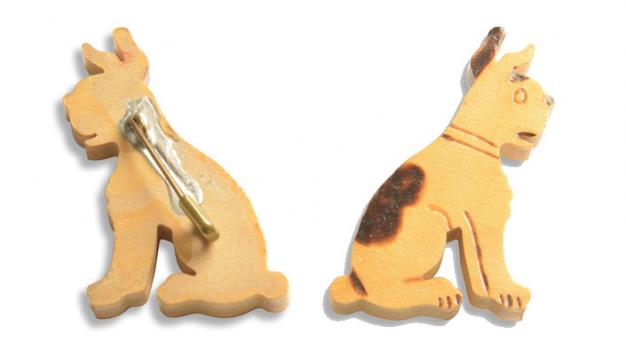
Wooden pin depicting “Snubs the Dog” from The Christian Science Monitor cartoon, n.d. 1989.18.
The history of cartoons in newspapers dates back to the nineteenth century. Since their beginning, they have been both political and comical.
Mary Baker Eddy founded The Christian Science Monitor in 1908. In its earliest days, cartoons were not included. Instead, it described in written form cartoons published in other newspapers. Then political cartoons began to appear irregularly as early as 1916, courtesy of Punch, a British paper.1 Political cartoons drawn specifically for the Monitor first appeared in 1919.2 They stopped the same year, but then resumed regular appearance in 1922.3
One of the Monitor‘s first non-political comics to run on a regular basis was “The Diary of Snubs, Our Dog,” written and illustrated by Paul R. Carmack (1895–1977). According to a 1998 Monitor article, he “got his idea for Snubs while watching puppies in a pet store window in Chicago,” where he attended the Art Institute.4 The comic first appeared in The Prairie Farmer, a Chicago newspaper where Carmack worked as art director and cartoonist after serving in the US Navy during World War I. Snubs began appearing in the Monitor in 1923, and Carmack joined the newspaper’s staff in 1925. By that time Snubs ran exclusively in the Monitor.
In his book Commitment to Freedom, longtime Monitor editor Erwin D. Canham described the newspaper’s process for cartoons:
To create a regular comic strip for the Monitor took a bit of doing. The usual blood-and-thunder sequences were not welcome. The Monitor also had to have strips exclusive to itself, since it could not publish syndicated material that was available to readers of other newspapers before they could get the Monitor. Nearly all other newspapers simply buy comic strips from a syndicate. The total cost is spread over a large number. Elaborate teams of collaborators produce the famous strips. The Monitor must pay the entire cost of production of each of its strips.5
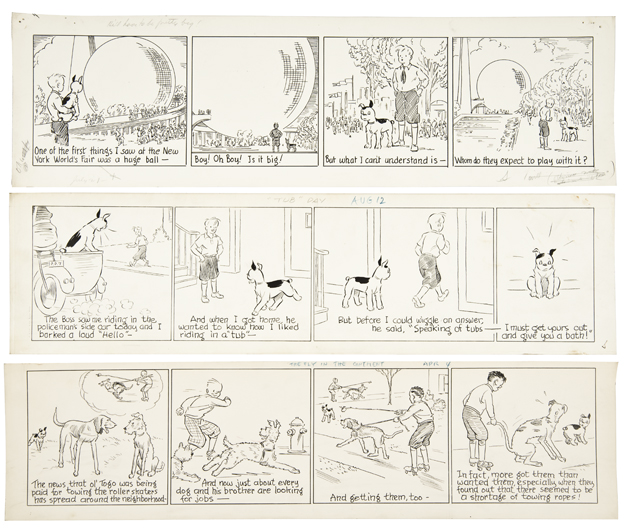
Cartoons appearing in The Christian Science Monitor, 1938 and 1939.
From 1924 to 1934, various small presses published five books of Snubs comics from the Monitor. Eventually Carmack’s other work for the newspaper, as a political cartoonist, took precedence over writing and illustrating Snubs. In 1939 the comic became the responsibility of Richard Rodgers, who handled it until 1947, when Ted Miller took the reins. He drew Snubs until its run ended in 1954. Carmack drew political cartoons for the Monitor full-time from 1939 until his retirement in 1961.
Along with a few other Monitor comics, Snubs was suddenly stopped on August 31, 1954. Canham later explained his decision for this as editor, stating the importance of keeping comics fresh, as well as of saving money. “The Monitor…can obtain, at rates it can afford to pay, an excellent selection of drawings comparable to those for which the slick magazines pay a much higher figure,” he noted. “Compared to the paper’s former strips [such as Snubs], the humor is more adult, more professional, and yet entirely wholesome.”6 Canham also noted the reaction:
Readers who had been brought up on Snubs protested pathetically, despite the fact that Mr. Carmack had been forced to leave him [Snubs] to a contributing artist for some years. It was virtually impossible to retain his original verve and freshness.7
We have in the collections of The Mary Baker Eddy Library a decorative pin depicting Snubs. It is contemporary folk art, made of a light wood with a safety pin attached on the back. It is quite small, measuring in at just 1-3/4 inches in length and 1 inch in width. The dog’s spots are likely the product of wood burning. Unfortunately, we do not know anything about the origin of the piece, whether or not it was ever worn, or by whom. It was donated by a longtime employee of The Christian Science Publishing Society, who worked at the Monitor in the 1930s and 40s. Although we do not know how she came by the pin, it is interesting to note that her donation also included copies of the Snubs, Our Dog cartoon books.
Is it possible that the Snubs pin was crafted by Paul Carmack or one of the artists who later worked on the comic? We don’t know. If anyone has more information on the creator of this piece, please contact the Library’s Research Room at [email protected].

- “A Willing Victim,” The Christian Science Monitor, 28 April, 1916.
- Editorial Cartoon, Monitor, 16 April, 1919.
- Editorial Cartoon, Monitor, 3 February, 1922.
- “When Snubs and Tubby Ruled the Comic Pages,” Monitor, 25 November, 1998.
- Erwin D. Canham, Commitment to Freedom: The Story of The Christian Science Monitor (Boston: Houghton Mifflin, 1958), 359–60.
- Canham, Commitment to Freedom, 361.
- Canham, Commitment to Freedom, 361.