
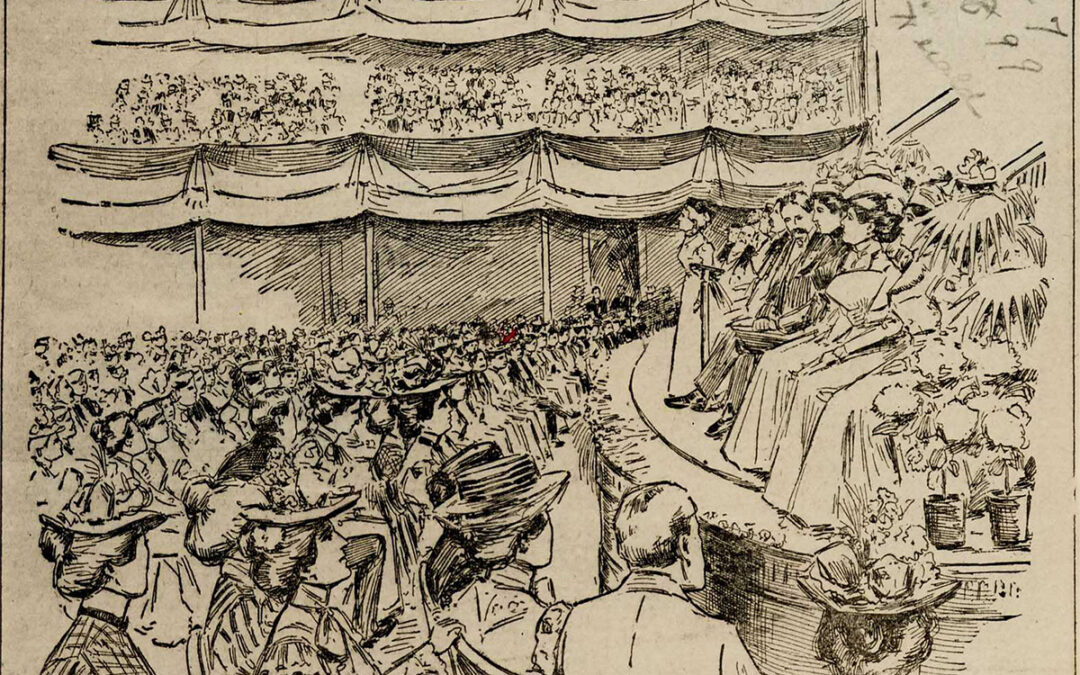
Sketch of Mary Baker Eddy speaking at the Annual Meeting of The First Church of Christ, Scientist, Tremont Temple, Boston, 1899. Boston Herald. P04950.
(Updated January 20, 2026)
We are sometimes asked if Mary Baker Eddy’s voice was ever captured. While the technology existed during her lifetime, no audio or film recordings were ever made (although numerous photographs of her exist in The Mary Baker Eddy Library’s collections). Here is some background.
Sarah Pike Conger was a Christian Scientist who worked for peace in China during the Boxer Rebellion of 1899–1901 and kept up a correspondence with Eddy. On August 1, 1910, Conger wrote to Eddy’s secretary Irving C. Tomlinson, asking if she would consider having her voice recorded. Tomlinson quotes Conger’s letter in his reminiscence, including her explanation for that request:
My heart’s inmost loving gratitude for [hearing Eddy’s voice] can not be told and my treasured thought is this — that more might hear that voice, in its earnestness, its intonation, its tenderness, its thrill of superior understanding. This desire has come to me through the living word uttered to me by dear Mrs. Eddy herself. There are instruments perfected to a great extent which are very true to the human voice. Would it not be wise if our dear Leader could speak into these instruments in her sweet, tender, positive tones passages from the Bible and selections from some of her wonderful writings?
Tomlinson noted that he presented Conger’s request to Eddy and asked her if she would be willing to have her voice recorded, but she declined.1
Another member of Eddy’s staff, John Salchow, noted in his reminiscence a third-hand account of Eddy declining to record her voice: “Mr. Joseph Mann once told me that Mr. Alfred Farlow had asked Mrs. Eddy to have her voice recorded and that she had said she did not care to as it would be of no interest to the world.” While Salchow and Mann were groundskeepers, Mann also studied Christian Science with Eddy. Farlow was also her student, as well as Committee on Publication for The First Church of Christ, Scientist (The Mother Church).2
There are, however, numerous descriptions of Eddy’s voice, according to the reminiscences of people who met her. Mary Stewart, another of Eddy’s students who also worked for her, in recounting the first interview she had with Eddy, described her voice at that time as “colorful, firm, refined,” adding that “she talked with her lips, her eyes, her hands, and from her heart.”3 Calvin C. Hill, a Sunday School Superintendent of The Mother Church, recalled that Eddy gave an address with “a voice resonant with spiritual power and beauty, and with articulation so distinct that not a syllable was lost.”4
Multiple reminiscences imply that, in the public addresses Eddy gave, she would adapt the tone of her voice to support the message she intended to convey. An account by Annie Louise Robertson, one of Eddy’s students, states that in addition to clear enunciation her voice “without effort, had the most unusual carrying power.”5 As a whole, students described her voice in terms of being varied, based on the import of the words she was speaking at the time.
According to Tomlinson, Eddy also appreciated music and “sang soprano in a little home quartet.” And he went on to remark, “I well remember the sweet quality of her voice.”6
For more information on Eddy’s use of technology, read the article “Technology in Mary Baker Eddy’s Household.”

- Irving C. Tomlinson, “Mary Baker Eddy: the Woman and the Revelator,” 1932, Reminiscence, 676–677.
- John Salchow, “Reminiscences of Mr. John G. Salchow,” 1932, Reminiscence, 53.
- We Knew Mary Baker Eddy, Expanded Edition, Volume I (Boston: The Christian Science Publishing Society, 2011), 318.
- We Knew Mary Baker Eddy, Expanded Edition, Volume I, 326.
- We Knew Mary Baker Eddy, Expanded Edition, Volume I, 277.
- Tomlinson, Twelve Years With Mary Baker Eddy, Amplified Edition (Boston: The Christian Science Publishing Society, 1996), 216–217.