
From the Collections: The story of Christian Science radio broadcasting
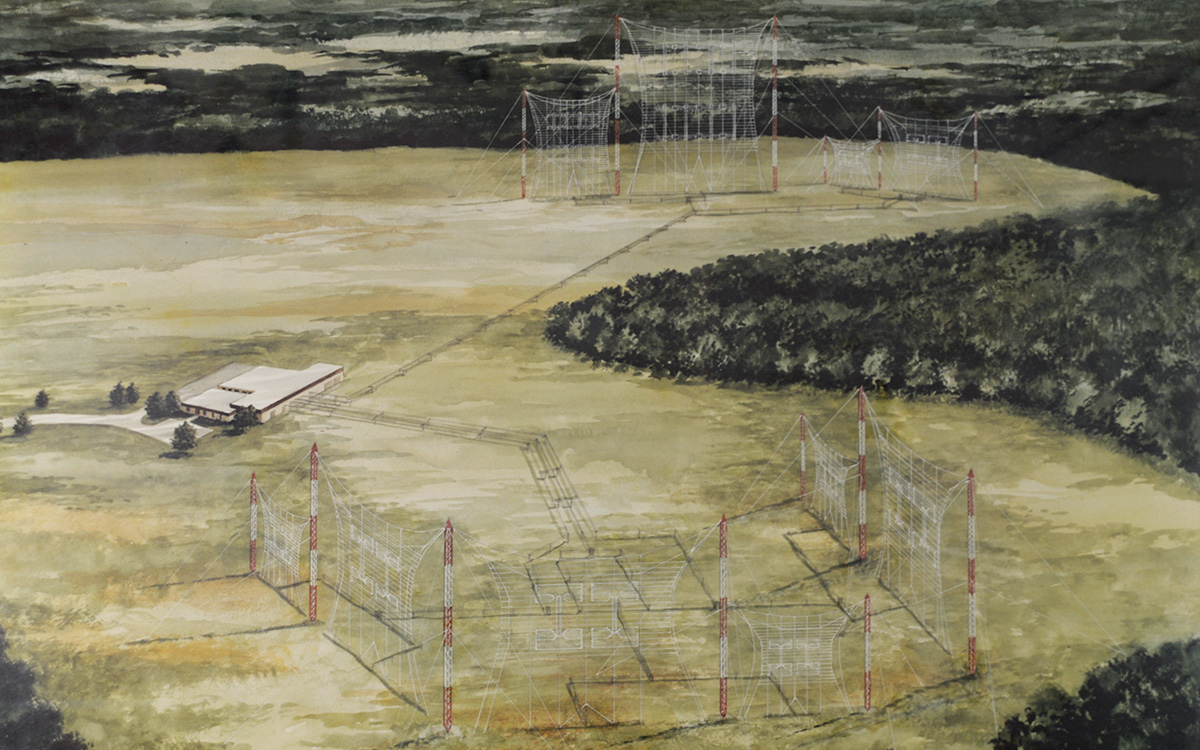
Artistic rendering of shortwave station WSHB in Cypress Creek, South Carolina, c. 1987. 00387. Peter Ferber.
The Mother Church (The First Church of Christ, Scientist, in Boston, Massachusetts) has used a variety of media to convey the message of Christian Science. Radio was one such avenue, and the Church was an early adopter of that once-novel technology. Its broadcasting efforts have since evolved to reach local and international audiences with impactful programming, creating a radio production and distribution history that has now spanned eight decades.
Early history
The wireless transmission of information emerged at the turn of the twentieth century. However, what we think of today as radio began taking shape in the early 1900s. Radio broadcasting for entertainment purposes started around 1910, and the first commercial radio station was organized in 1920.1 By the early-to-mid 1920s, radio was becoming a dominant form of mass communication.2The Mother Church paid attention to this growing medium.
Although Church founder Mary Baker Eddy did not own a radio, she did embrace many of the technological advances of her time, including the telephone and home electricity. She also owned automobiles as early as 1902, although she herself preferred a horse and carriage.3 However, Eddy did foresee advances in mass communication. Irving Tomlinson, who served on her staff and assisted her in other ways from about 1898 to 1910, noted this in his 1932 reminiscence: “… The radio as we are familiar with it today was unknown to Mrs. Eddy, though many years prior to the writer’s acquaintance with her she had prognosticated the use of wireless telegraphy.”4
One of the first mentions of radio in The Mother Church’s periodicals was in early 1923, when the Christian Science Sentinel briefly touched on the benefits of the new medium, especially noting its potential to elevate humanity. “The new radio activity,” wrote author Harriet L. Betts, “is symbolizing the story of a capacity now awakening in human thought, not as though a new thing had come, but because a new activity of thought is superseding former dullness.”5
First broadcast
As radio became more widespread, its utilitarian value came into focus. According to author and news media professional Susan Bridge, it was understood as far back as the 1920s that radio, to a degree, should be educational and serve the public.6 Radio stations of the time considered religious programming to be of public interest.
The Mother Church aired its first radio broadcast on October 7, 1923, when its Sunday morning church service was carried live on the Boston radio station WNAC. The Church did not have any immediate plans for future transmissions—that radiocast was viewed as “wholly experimental.”7 But evidently the results were fruitful, as broadcast services continued on WNAC for the remainder of 1923.8 Services were subsequently aired on various Boston radio stations—and even for a few years on a Providence, Rhode Island, station—until about 1951.9
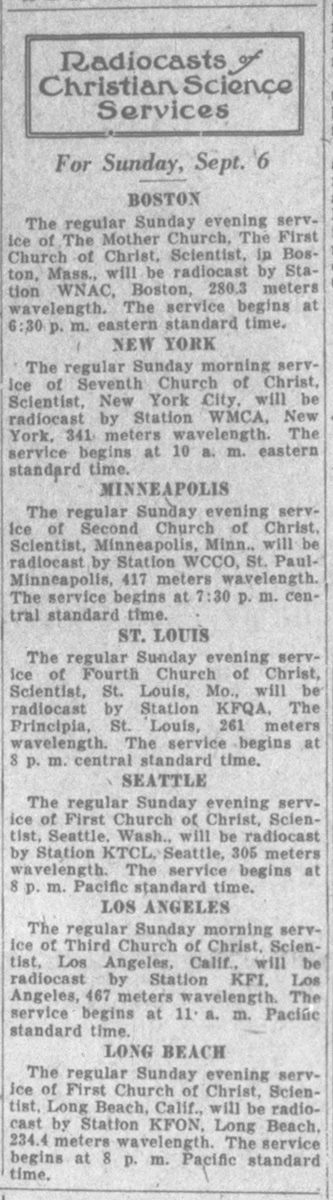
List of local Christian Science services broadcast by branch Churches of Christ, Scientist for September 6, 1925. Printed in the September 4, 1925 issue of the Monitor.
Around the same time, some Christian Science branch churches also started to broadcast their own church services, in addition to those from The Mother Church.10 Branch churches were also increasingly airing Christian Science lectures and instructions for listing radio broadcasted lectures first appeared in the Sentinel in 1924.11 News of lecture broadcasts from as far as Johannesburg, South Africa, and Shanghai, China, soon reached Boston.12
A newspaper hits the airwaves
The Christian Science Monitor also adopted the new technologies. Wireless receivers promised to shorten the time it would take for a reporter’s story to reach the newsroom. After a group of newspapers opened up one of the first radio transmission stations for this purpose in Halifax, Nova Scotia, the Monitor quickly invested in that organization.13
The radio was also a novel medium for sharing the Monitor. On April 14, 1930, the newspaper debuted its program The Monitor Views the News on Boston radio station WHDH.14 The broadcast went on to become a flagship news and commentary program, with several different hosts and formats. Broadcast until 1955, the show was also beamed around the world on shortwave station W1XAL (later WRUL) from late 1934 until at least 1953.15 Its most well-known iteration was titled The Christian Science Monitor Views the News, hosted by Erwin D. Canham, the paper’s editor from 1945 to 1964. During his tenure as host, the radiocast aired on affiliate stations of the American Broadcasting Company (ABC), which in 1953 numbered over 120.16
As the Monitor’s broadcasting activities grew, so did its radio operations. When the new Christian Science Publishing House was fully opened in Boston in 1935, it served as headquarters of The Mother Church’s publishing efforts.17 A studio had been built on the building’s top floor for radio recording, and the Monitor first used it in July 1934. From that studio, the newspaper recorded radio news updates, as well as its commentary program, and sent them out for distribution by Christian Science Committees on Publication, who were responsible for communicating with the public in their local areas.18
Growth and streamlining
An article in the February 1929 issue of The Christian Science Journal noted that “the bread of Life may be broken to millions of hungry hearts” simultaneously, thanks to the aid of radio.19 With this sentiment in mind, the Christian Science Board of Directors announced in the Sentinel on October 24, 1931, that the distribution of radio broadcasts would be handled locally by branch churches and Committees on Publication. With this directive, the Church’s religious programming was no longer centered in Massachusetts but could be heard throughout the country.20 By the early 1950s this task would be handled by the Committees on Publications exclusively.21
During this time words of appreciation for the Monitor’s broadcasts quickly poured in. Among the many letters, a Baptist preacher in Rhode Island told his congregation in 1932 to tune in to The Monitor Views the News: “This is a broadcast which has been enjoyed by many of us because the sensational is omitted and a complete review of the really important happenings of the day is given in an enlightening manner.”22
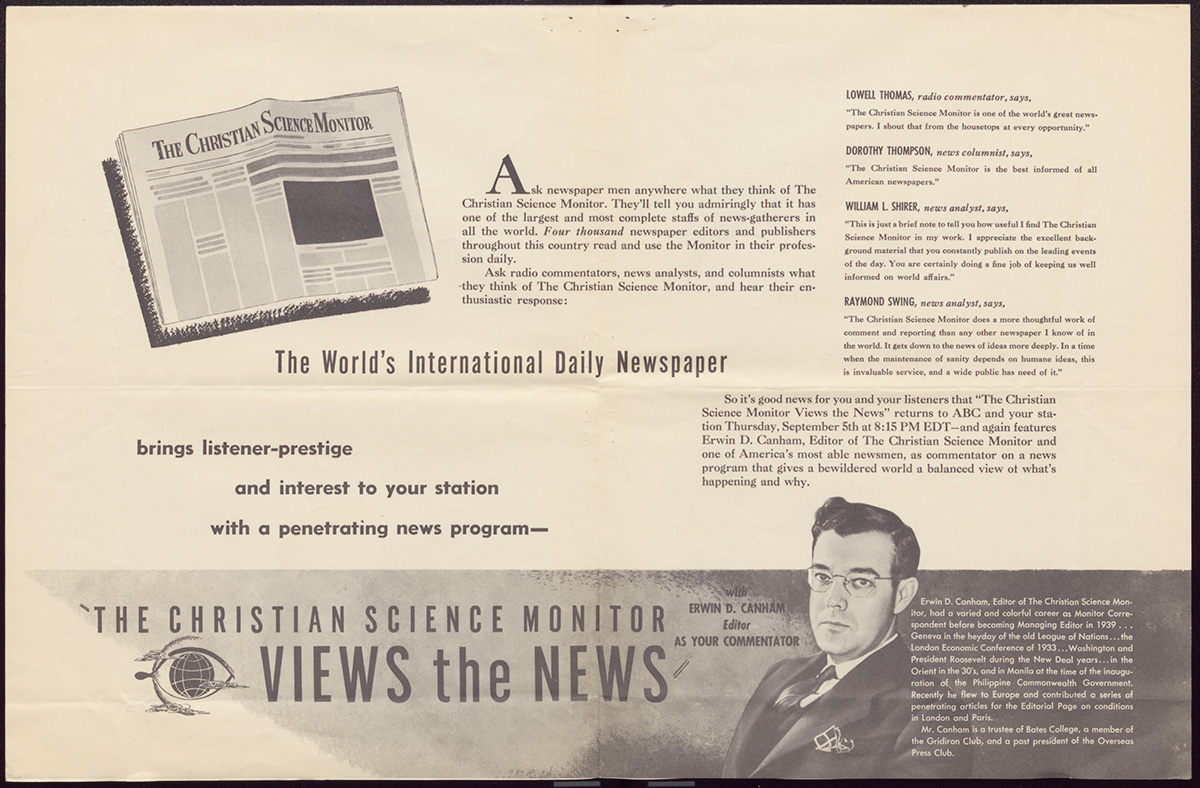
Advertisement for The Christian Science Monitor Views the News, hosted by Erwin Canham, 1946. Notice the level of attention the print edition of the Monitor received in this ad. Church Archives, Box B18742, Folder F197184.
In 1934 one Monitor news broadcaster reported that—in response to the radiocasts—1,000 complementary copies of the Monitor had been distributed, subscription rates increased, and sales of the physical paper also grew.23
Also in the 1930s, The Mother Church started to broadcast additional religious programming to its Boston audience. On April 5, 1932, a series titled the Good Cheer Service began on the Needam, Massachusetts, radio station WBSO. Produced by the Office of the Committee on Publication, the show included readings from both the Bible and authorized Christian Science literature.24 Thus, Christian Science Committees on Publication across America also began to arrange and produce similar radio broadcasts locally, and the results proved beneficial. Besides reports of healings, C. Augustus Norwood, then Manager of Committees on Publication, shared in 1934 that these broadcasts catalyzed further interest in Christian Science and resulted in the increase in sales of Christian Science literature.25 By 1946 Christian Science radio shows aired on about 200 stations throughout the world.26
Adventures in shortwave
For further reach, The Mother Church also utilized shortwave radio. Its first foray into shortwave broadcasting was in September 1930, when for one month it aired The Monitor Views the News on Boston station W2XAL for one month. Walter S. Lemmon, a radio inventor as well as a Christian Scientist, owned the station, and this marked the first partnership of its kind for the Church.27 In 1931 Lemmon organized a new shortwave station in Boston, W1XAL, which he later managed and operated in partnership with the World Wide Broadcast Foundation. By 1935 the station had grown in operation, thanks in part to grants from philanthropic organizations like the Rockefeller Foundation, and over time its signal reached all corners of the globe.28 In 1934 The Mother Church began airing a religious shortwave program on W1XAL consisting of readings from the Bible and Christian Science literature, as well as The Monitor Views the News.29 According to Canham, the Church was more than happy to collaborate with Lemmon and his radio station. According to Canham’s 1958 book Commitment to Freedom: The Story of The Christian Science Monitor, the Church likely also shared the sentiment that “[W1XAL] was noncommercial, and since it was both nongovernmental and established in Boston, the Monitor was glad to help as a public service.”30
Beginning in April 1935, services of The Mother Church were broadcast on W1XAL, reaching an audience outside of Boston for the first time.31 The Church received many letters of gratitude in response to these broadcasts. One Christian Scientist in South Africa shared, “I followed the whole service throughout just as though I was one of the congregation—which, of course, I really was. … I intend now to listen in every month, and almost wish it were every week.”32
Another letter from an individual in “a remote section of Maine” was also telling:
It means a great deal to hear a service from The Mother Church and all the other programs I can find, especially as I have not yet had the opportunity to attend any Christian Science service and have come in contact with but two Christian Scientists.33
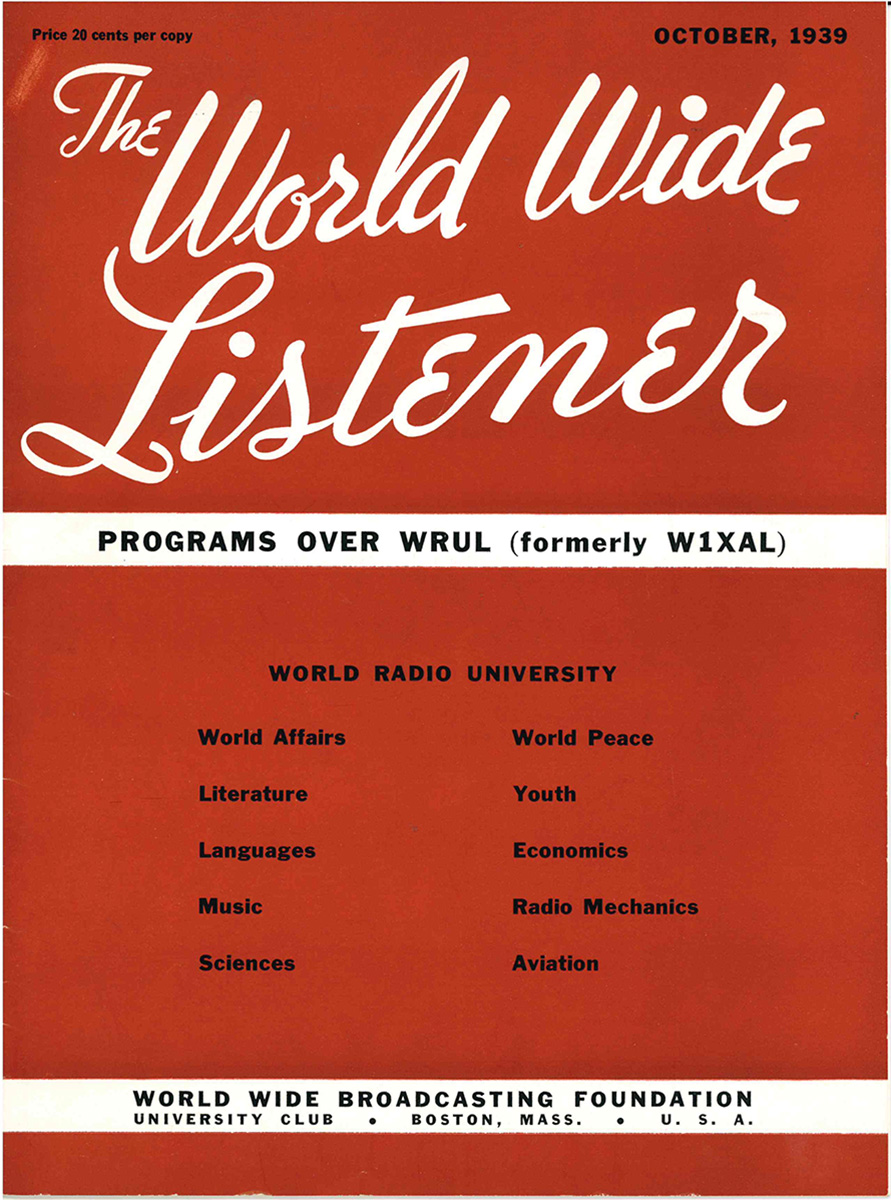
WRUL’s monthly periodical, The World Wide Listener, October 1939.
Renamed WRUL in 1939, the shortwave station broadcast The Mother Church services and other programs until about 1951. Between 1942 and 1947, civilian programming was discontinued, due to government control in connection with World War II.34
During World War II, the Monitor teamed up with the radio syndicate Mutual Broadcasting Network to assemble the show The World’s Front Page. First aired in 1943, the program featured nightly reports about the war from Monitor correspondents stationed along its various fronts.35
In his Committee on Publication report at the 1933 Annual Meeting of The Mother Church, Norwood indicated the Church’s radio work was leavening public thought.36 Over the years The Mother Church would continue that work by developing new religious programming. For example, a March 1947 radio show premiered on WRUL called Proof That Christian Science Heals. Each episode included readings from the Bible and various Christian Science publications. The broadcast was also the first to include the reading of published testimonials of those healed by Christian Science.37 That series was replaced by How Christian Science Heals in 1962, in which guests shared their own healing experiences.38 Subsequent programming included The Bible Speaks to You, which first aired in 1962, followed by The Truth That Heals, which began in 1971.39
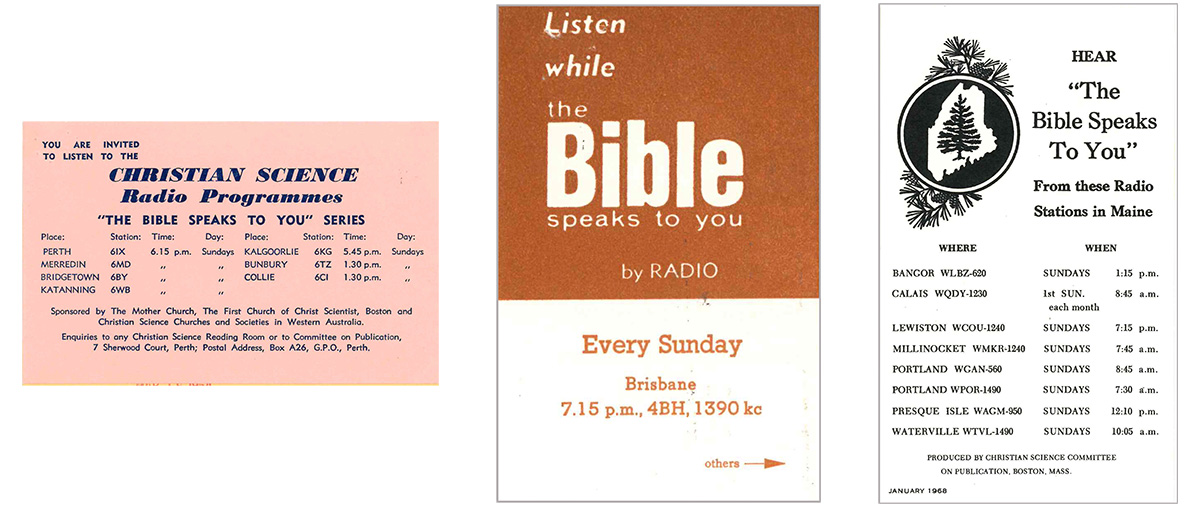
Promotional cards for The Bible Speaks to You radio program from Australia and the state of Maine, United States, circa 1968–1970. Church Archives, Box B1953, Folder F61756.
After The Christian Science Monitor Views the News ended in the mid-1950s, the newspaper did not return to broadcasting for over two decades. Then in 1977 the Monitor launched a subscription radio news service, which eventually included a network of over 200 stations.40
Radio resurgence
By the 1980s the public was increasingly turning to television for news and information. In response the Monitor launched a bold, new broadcasting venture in 1984, MonitoRadio.41 The program aired on public radio stations across the United States and eventually included a daily and weekend edition.42 Featuring news, commentary, and interviews with newsmakers, the program was designed to appeal to the young, sizable audience that public radio reached; research revealed that the Monitor newspaper appealed to the same demographics. Monitor Radio received acclaim and recognition, including several International Radio Festival awards.43
In March 1987 shortwave radio broadcasts began again. The vision of The Mother Church was to launch a shortwave network to distribute the healing message of Christian Science to a worldwide audience. In addition to WCSN, transmitting from Scotts Corners, Maine, the Church constructed two additional facilities over the course of the next few years. KYOI went on the air in Saipan, Mariana Islands, in June 1988. Then WHSB launched in April 1989, from Cypress Creek, South Carolina. Together the three stations beamed programming to all seven continents, including Mother Church Sunday services, the weekly Christian Science Bible Lesson, and the Radio Editions of the Christian Science Sentinel and The Herald of Christian Science. Herald Radio was broadcast in a variety of languages, including Spanish, German, and French, with a Russian broadcast introduced in January 1990.44
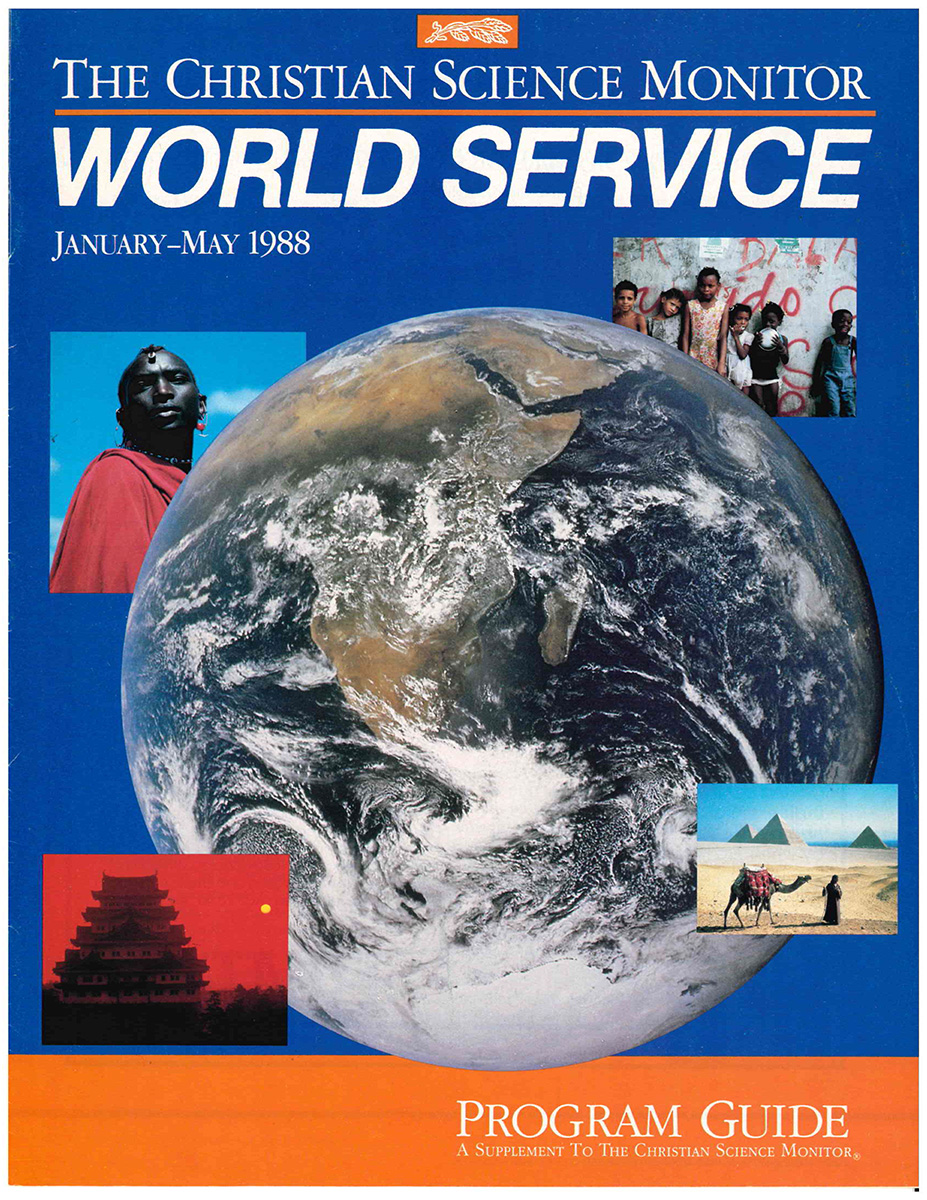
Program guide for The World Service of The Christian Science Monitor, January–May 1988, included in the December 29, 1987 issue of the Monitor. The bold cover design expressed the excitement the Christian Science Publishing Society felt for its shortwave broadcasting venture.
Additionally, the Monitor launched a new, two-hour radio newsmagazine, The World Service of The Christian Science Monitor. The Church viewed its commitment to shortwave as “a missionary activity” and, according to the booklet Christian Science: A Report For The ‘90s, Looking ahead to the 21st Century, it operated “the largest independent radio broadcasting system in the world.” As of 1990, the broadcasts reached over 5 million listeners a week.45
The Monitor went digital on May 30, 1996, launching a website to complement its print newspaper. The online site, which was innovative in numerous ways, included an online stream of Monitor Radio, making it one of the first sites to include such a feature.46 The Mother Church also made significant investments in radio at the end of the decade.
As in the early years of The Mother Church radio activities, numerous messages of gratitude again came in from around the world. This response from Cuba showcased the intimate nature of these audio programs: “… I must confess that I really don’t attend any church, the only things that bring me closer to God at the moment are reading the Bible and listening to you….”47 Another succinct, poignant note arrived from a listener in China: “It seems to me that the world is small because of your broadcast.”48
Signing off
By the late 1990s, listenership was in decline and The Mother Church decided to rethink its media ventures; the shortwave stations went up for sale in 1997. At the time, shortwave listenership in general was waning, a trend that led to fewer listeners. After that, local branch churches once again became responsible for Christian Science programming in their communities.49 The Mother Church also purchased broadcasting time on shortwave stations for the airing of Sunday services, the weekly Christian Science Quarterly Bible Lesson, and the Sentinel and Herald radio editions. Bible Lessons continued to be distributed on radio until about 2008; Sentinel radio shows were broadcast until 2011.50
Current initiatives
While today The Mother Church no longer utilizes radio, digital resources are a major avenue through which the message of Christian Science is spread. Through the Church’s website ChristianScience.com, visitors can listen to an audio broadcast of the live Sunday service, with playback available throughout the following week. An online testimony meeting is also streamed live every Wednesday at 2:00 p.m. Eastern Time, in which participants share their healing experiences. The Church also produces several Christian Science related podcasts.51 Today the Monitor produces a podcast called The Christian Science Monitor Daily, which provides a 10-minute summary of the day’s news. In addition, the Why We Wrote This podcast gives readers a peek into the news-gathering process.52

- “The Development of Radio,” PBS American Experience website, https://www.pbs.org/wgbh/americanexperience/features/rescue-development-radio/
- Susan Bridge, Monitoring the News: The Brilliant Launch and Sudden Collapse of The Monitor Channel (Armonk, NY: M.E. Sharpe, 1998), 5.
- For more on this, see “What were Mary Baker Eddy’s views on technology?” and “Yale automobile.”
- Irving Tomlinson, “Mary Baker Eddy: The Woman and the Revelator,” 1932, Reminiscence, 774.
- Harriet L. Betts, “Spiritual Activity,” Christian Science Sentinel, 3 March 1923, 525, https://sentinel.christianscience.com/shared/view/1huzmmkkyu4?s=copylink
- Bridge, Monitoring the News, 5.
- “Church Service By Radio,” The Christian Science Monitor, 27 September 1923, 2.
- “Mother Church Radio Service,” Monitor, 31 December 1923, 2.
- “Radiocasts of Christian Science Services,” Monitor, 1 May 1926, 14.
- “Annual Meeting of The Mother Church,” Sentinel, 16 June 1923, 831, https://sentinel.christianscience.com/shared/view/133a9z6wvhs?s=copylink
- “Notices,” Sentinel, 29 March 1924, 612, https://sentinel.christianscience.com/shared/view/133a9z6y5po?s=copylink
- “Reports from the Field,” Sentinel, 27 June 1931, 849, https://sentinel.christianscience.com/shared/view/1qq0hdmo2e0?s=copylink; “Items of Interest,” Sentinel, 14 January 1933, 391, https://sentinel.christianscience.com/shared/view/2hb3096pl38?s=copylink
- Robert W. Desmond, Windows on the World: The Information Process in A Changing Society, 1900–1920 (Iowa City, IA: University of Iowa Press, 1980), 460.
- “Monitor Completes Plans to Go On Air,” Monitor, 12 April 1930, 1.
- “New Short-Wave Programs,” Monitor, 13 December 1934, 17; “Annual Meeting of The Mother Church,” The Christian Science Journal, July 1953, 350, https://journal.christianscience.com/shared/view/2la991ozc9i?s=copylink
- “Annual Meeting of The Mother Church,” Journal, July 1953.
- See “From the Collections: The Christian Science Publishing House.”
- “Monitor Opens Radiocast Studio In Own Building,” Monitor, 11 July 1934, 4.
- Clara Schrader Streeter, “The Bread We Break,” Journal, February 1929, 601, https://journal.christianscience.com/shared/view/1bzoy7xg6ty?s=copylink
- “From the Directors,” Sentinel, 24 October 1931, 151, https://sentinel.christianscience.com/shared/view/1jtx47sxqxc?s=copylink
- “Annual Meeting of The Mother Church,” Journal, July 1951, 336, https://journal.christianscience.com/shared/view/2m9pcev0d02?s=copylink
- Rev. W.D. Callender, “The Monitor Views the News,” The Central Baptist Church, June 1932.
- “Notices,” Sentinel, 7 July 1934, 902, https://sentinel.christianscience.com/shared/view/2p6mj2ve8w4?s=copylink
- “Christian Science Reading Over Radio,” Monitor, 2 April 1932, 2.
- “Notices,” Sentinel, 7 July 1934, 902, https://sentinel.christianscience.com/shared/view/2osgziccneq?s=copylink
- “Annual Meeting of The Mother Church,” Journal, July 1946, 324, https://journal.christianscience.com/shared/view/2deoi4cc02e?s=copylink
- “Monitor News Feature Heard on Short Waves,” Monitor, 6 September 1930, 16.
- Malcolm L. Richardson, “Radio Boston Goes to War: The ‘Strange Case of WRUL’ Revisited,” Journal of Contemporary History, June 2025, 3–4.
- “New Short-Wave Programs,” Monitor, 13 December 1934, 17.
- Erwin Canham, Commitment to Freedom: The Story of The Christian Science Monitor (Boston: Houghton Mifflin Company, 1958), 310.
- “Items of Interest,” Sentinel, 20 April 1935, 671, https://sentinel.christianscience.com/shared/view/jzmxjdp2ti?s=copylink
- “Item of Interest,” Sentinel, 13 March 1937, 552, https://sentinel.christianscience.com/shared/view/1jfq8vaxhtq?s=copylink
- “Items of Interest,” Sentinel, 25 August 1934, 1039, https://sentinel.christianscience.com/shared/view/d3i9z75sdy?s=copylink
- “WRUL to Resume Programs On Feb. 27 in 10 Languages,” Monitor, 26 February 1947, 3. From its earliest years, WRUL’s signal reached Europe, and the station continued to broadcast to the continent during World War II. Before the government takeover of his station, Lemmon beamed programming there that countered Nazi propaganda. The Nazis were furious at WRUL and later murdered a relative of one of its employees. See “Beginning to Hurt,” Boston Sunday Post, 22 November 1942; “Nazis Bitter at Hub Radio,” Boston Post, 26 June 1942.
- Canham, Commitment to Freedom, 310.
- “Annual Meeting of The Mother Church,” Sentinel, 17 June 1933, 827, https://sentinel.christianscience.com/shared/view/2gwxgonpa4u?s=copylink
- “Mother Church World-Wide Series Scheduled to Begin on Radio March 2,” Monitor, 20 February 1947, 3.
- Transcripts of the program How Christian Science Heals are available through JSH-Online: https://jsh.christianscience.com/content/search/(offset)/20?SearchText=%22How+Christian+Science+Heals%22&PrimarySort=1&SearchPageLimit=2&SearchPageLimit=2
- ”Notices,” Sentinel, 24 February 1962, https://sentinel.christianscience.com/shared/view/13ad1ckhhba?s=copylink; “New Christian Science radio series announced,” Monitor, 26 December 1970, 3.
- “Fund for Monitor Announced,” The Christian Science Monitor, 6 June 1978, 6.
- Bridge, Monitoring the News, 3.
- Monitor radio programs were recently digitized and can be accessed online: https://americanarchive.org/catalog?f%5Bcontributing_organizations%5D%5B%5D=Christian+Science+Publishing+Society+%28MA%29&f[access_types][]=online
- Bridge, Monitoring the News, 53, 55.
- Christian Science: A Report For The ‘90s, Looking ahead to the 21st Century, 58.
- “Annual Meeting of The Mother Church 1989,” Journal, September 1989, 20–21, https://journal.christianscience.com/shared/view/dj1pc3i2v6?s=copylink; Christian Science: A Report For The ‘90s, Looking ahead to the 21st Century, 58.
- Laurent Belsie, “Live Radio and News At the Click of a Mouse,” Monitor, 31 May 1996, 3.
- A Report For The ‘90s, 55.
- A Report For The ‘90s, 64.
- “Christian Science Church Puts Radio Up for Sale,” Monitor, 15 April 1997, 4.
- Warren Bolon and Jeffrey Hildner, “Healing messages for everyday study and Sunday sermons,” Journal, July 2004, 27–28, https://journal.christianscience.com/shared/view/191cp1hyg0y?s=copylink; Anita Byth, “Reading Room on the radio,” Sentinel, 27 August 2012, 22, https://sentinel.christianscience.com/shared/view/nxfcu7gwha?s=copylink; Sentinel Radio programs can be listened to via JSH-Online: https://sentinel.christianscience.com/sentinel-audio/sentinel-radio-edition/
- See “Sunday and Wednesday church services,” https://www.christianscience.com/publications-and-activities/church-services; all of The First Church of Christ Scientist’s podcasts can be found on the “Christian Science Audio” landing page: https://www.christianscience.com/publications-and-activities/christian-science-audio
- See “Podcasts,” https://www.csmonitor.com/Podcasts.