
Mary Baker Eddy’s visit to President Garfield’s assassin
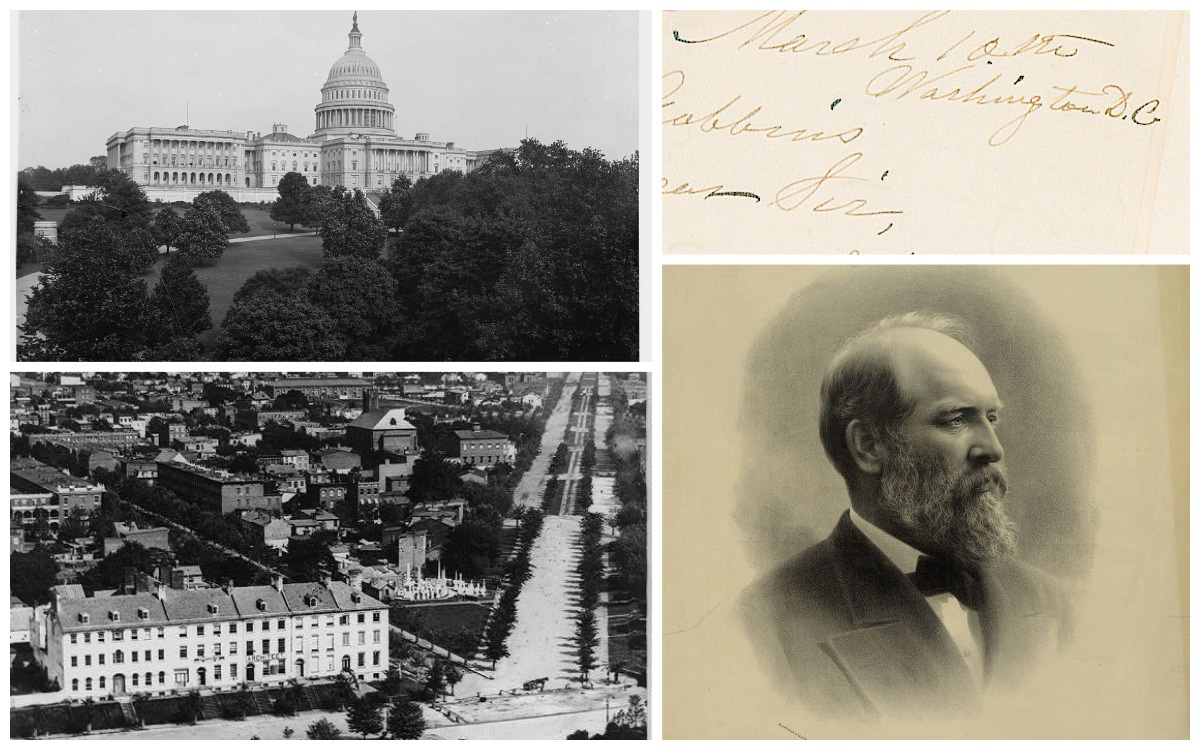
Clockwise from top left: Washington, DC, c. 1880–1897. William Henry Jackson; Mary Baker Eddy to Edwin R. Robbins, March 10, 1882. L04065; Print of President James A. Garfield, c. October 5, 1881. W.J. Morgan & Co.; SE view from U.S. Capitol dome, 1880. Levin C. Handy. Courtesy Library of Congress, Prints & Photographs Division, LC-DIG-det-4a03942; LC-DIG-pga-03146; LC-USZ62-53506.
We are sometimes asked about Mary Baker Eddy’s interactions with Charles J. Guiteau, the man who assassinated U.S. President James A. Garfield. Did she in fact visit him in prison, and if so, was she able to help him?
Born in Freeport, Illinois, on September 8, 1841, Guiteau was a failed insurance salesman and attorney with a history of unstable behavior. After a period of political engagement, he felt he was owed a position in Garfield’s administration. When that was not forthcoming, Guiteau ceased his support of the President. He came to believe that Garfield needed to be removed, shooting him at a Washington, D.C., train station on July 2, 1881.1
Guiteau was captured at the scene by a local police officer and imprisoned at a jail in southeast Washington.2 It was there that his encounter with Eddy took place. Early in 1882, she and her husband, Asa Gilbert Eddy, visited the city. She was speaking about Christian Science, giving 12 lectures in the course of their nine-week trip.3 Her husband was researching copyright law.
Although Guiteau’s visitors were strictly limited, The Washington Post reported that on February 12, several individuals came to see him in his cell.4 Convicted at trial on January 25, he had been sentenced to death by execution.5 Though few were allowed to speak with Guiteau, Eddy was apparently among those who did.6 She detailed the experience in an 1895 speech she gave to alumni of the Massachusetts Metaphysical College, which was later republished in her book Miscellaneous Writings 1883–1896:
The mental stages of crime, which seem to belong to the latter days, are strictly classified in metaphysics as some of the many features and forms of what is properly denominated, in extreme cases, moral idiocy. I visited in his cell the assassin of President Garfield, and found him in the mental state called moral idiocy. He had no sense of his crime; but regarded his act as one of simple justice, and himself as the victim. My few words touched him; he sank back in his chair, limp and pale; his flippancy had fled. The jailer thanked me, and said, “Other visitors have brought to him bouquets, but you have brought what will do him good.”7

- The president died on September 19 as a result of the injuries. See Jay Bellamy, “A Stalwart of Stalwarts: Garfield’s Assassin Sees Deed as a Special Duty,” Prologue Magazine, National Archives, June 13, 2024, https://www.archives.gov/publications/prologue/2016/fall/guiteau; “Charles Guiteau Collection,” Georgetown University Archival Resources, Georgetown University, October 2023, https://findingaids.library.georgetown.edu/repositories/15/resources/10031.
- “Charles Guiteau Collection,” Georgetown University Archival Resources, Georgetown University, October 2023, https://findingaids.library.georgetown.edu/repositories/15/resources/10031.
- Julia S. Bartlett, “A Worker in the Massachusetts Metaphysical College,” in We Knew Mary Baker Eddy, Expanded Edition, Volume I (Boston: The Christian Science Publishing Society, 2011), 56. Circular, n.d., Subject File, Eddy, Mary Baker – Visits to – Washington, D.C.
- “Guiteau’s Sunday,” The Washington Post, 13 February 1882, 4.
- Guiteau was executed on June 30, 1882.
- Biographer Robert Peel suggests that one of Eddy’s politically-connected relatives in Washington—either Henry Moore Baker or Fanny McNeil Potter—may have facilitated the visit. See Mary Baker Eddy: The Years of Trial, second edition (Boston: The Christian Science Publishing Society, 2024), 144–145.
- Miscellaneous Writings 1883–1896, Mary Baker Eddy, 112.